Research sampling
Select eligible paddy farmers
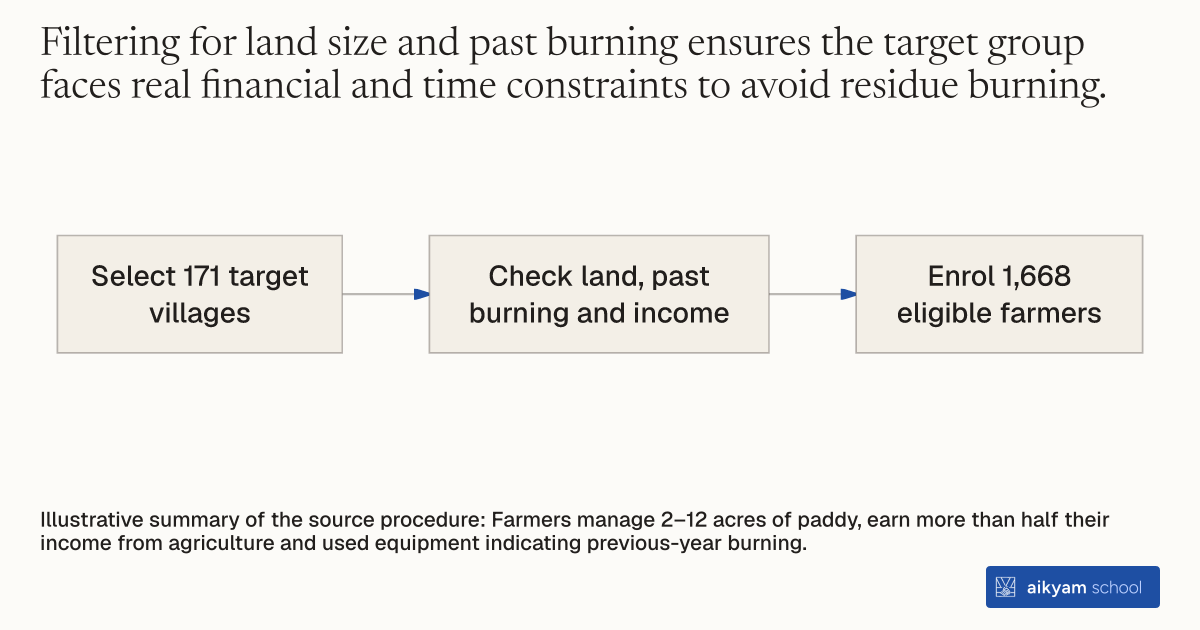
- Select 171 target villages
- Check land, past burning and income
- Enrol 1,668 eligible farmers
Illustrative summary of the source procedure: Farmers manage 2–12 acres of paddy, earn more than half their income from agriculture and used equipment indicating previous-year burning.
See source →How
When to use
Programs addressing agricultural residue burning need to target farmers who actively engage in stubble burning and manage specific plot sizes. Unfocused sampling risks enrolling non-burners or households outside the policy-relevant scale. This selection method identifies active, resource-constrained paddy cultivators across high-burning geographic clusters.
Select a representative sample of active paddy farmers across targeted high-burning districts using multi-stage geographic filtering.
- Identify high-burning agricultural districts using historical regional residue burning data.
- Select 171 target villages within the chosen districts.
- Filter local agricultural households to find those managing between 2 and 12 acres of paddy cultivation.
- Verify that target households used equipment indicating crop residue burning in the previous year.
- Confirm that households derive more than half of their income from agriculture.
- Enroll 1,668 eligible farmers into the target evaluation sample.
Why it works
Enrolling commercial smallholders maximizes policy relevance for regional pollution reduction programs.
Example
Researchers identified 1,668 farmers managing 2 to 12 acres of paddy across 171 villages in Bathinda and Faridkot, Punjab, India. These farmers earned an average annual agricultural profit of INR 114,000 (US $1,415) and used equipment showing they burned residue the prior year.
About the study
Participants
1,668 farmers with 2 to 12 acres of paddy across 171 villages in Bathinda and Faridkot, Punjab, India.
Study Design
Multi-stage sample selection combining district-level burn density data, land holding filters, and past equipment usage indicators.
Results
Selected households had a baseline annual agricultural profit averaging INR 114,000 (US $1,415) in the comparison group, with 90.1% of control farmers continuing to burn residue during the study period.