Try, learn and adjust
Check the stated job-seeker eligibility criteria
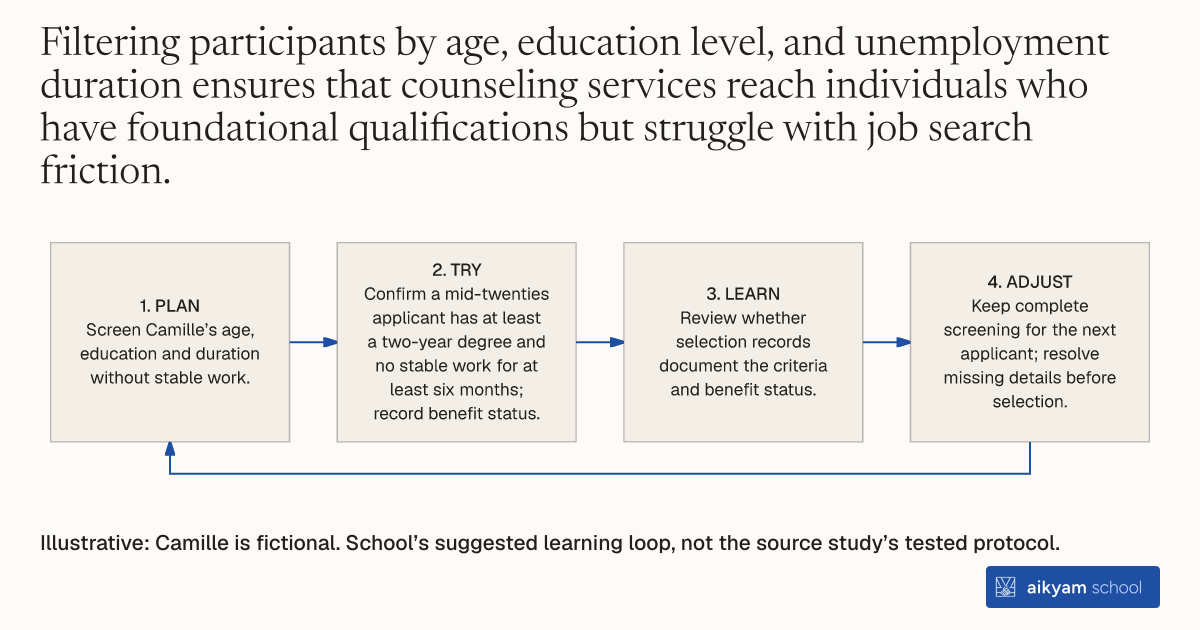
- Plan: Screen Camille’s age, education and duration without stable work.
- Try: Confirm a mid-twenties applicant has at least a two-year degree and no stable work for at least six months; record benefit status.
- Learn: Review whether selection records document the criteria and benefit status.
- Adjust: Keep complete screening for the next applicant; resolve missing details before selection.
Illustrative: Camille is fictional. School’s suggested learning loop, not the source study’s tested protocol.
See source →Observe age, qualification, work history and benefit status; lack of benefits is recorded, not added as an eligibility requirement. School suggests this learning loop; it was not tested by the source.
How
When to use
In many countries, youth face high unemployment after leaving school because they lack sufficient work history to claim unemployment benefits or secure stable jobs. Selecting eligible participants based on clear education level and unemployment duration criteria helps focus active labor market programs on job seekers who need intervention. This approach serves young, college-educated individuals who have spent extended periods searching for stable work.
Identify and select eligible young job seekers using specific demographic and employment criteria.
- Screen job seekers to confirm they are in their mid-twenties and hold at least a two-year college degree.
- Verify that candidates have not held stable work for at least six months.
- Check whether candidates are receiving government unemployment benefits, noting that many who lack sufficient employment history do not receive them.
- Select the eligible pool to participate in employment support programs across target local communities.
Why it works
It targets resources to those whose main barrier is finding initial stable employment rather than basic skills acquisition.
Example
In France between 2007 and 2010, researchers and Ministry of Labor officials selected nearly 30,000 job seekers in their mid-twenties who held at least a two-year degree and had been without stable work for at least six months. Two-thirds of the selected group were women, and 67 percent were not receiving unemployment benefits.
About the study
Participants
Nearly 30,000 young job seekers in their mid-twenties possessing at least a two-year college degree, unemployed for at least six months, two-thirds female, and 67 percent not receiving unemployment benefits across 235 communities in ten regions throughout France.
Study Design
Randomized controlled trial tracking eligible job seekers randomly assigned to receive specialized counseling services or standard public counseling over a two-year follow-up period.
Results
Offering counseling to selected job seekers increased long-term employment by 2.5 percentage points after eight months compared to untreated peers in the same areas, but take-up was only 35 percent and gains disappeared after twelve months.