Try, learn and adjust
Check crop rows and targeted fertiliser placement
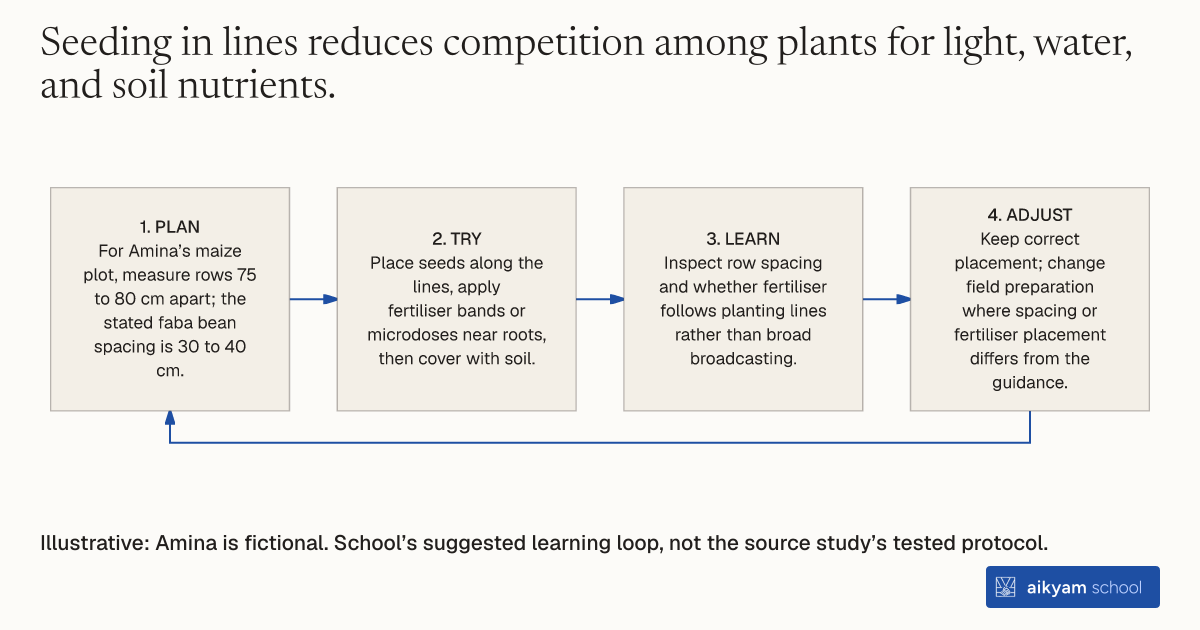
- Plan: For Amina’s maize plot, measure rows 75 to 80 cm apart; the stated faba bean spacing is 30 to 40 cm.
- Try: Place seeds along the lines, apply fertiliser bands or microdoses near roots, then cover with soil.
- Learn: Inspect row spacing and whether fertiliser follows planting lines rather than broad broadcasting.
- Adjust: Keep correct placement; change field preparation where spacing or fertiliser placement differs from the guidance.
Illustrative: Amina is fictional. School’s suggested learning loop, not the source study’s tested protocol.
See source →Observe crop-specific row spacing and root-targeted application; no seed interval or fertiliser dose is invented. School suggests this learning loop; it was not tested by the source.
How
When to use
Smallholder farmers routinely plant cereal crops by broadcasting seeds and fertilizers across fields by hand. Traditional broadcasting creates spatial competition among seedlings, wastes inputs, and makes weeding difficult. Planting seeds in target lines and applying inputs directly to crop root zones optimizes plant spacing and reduces fertilizer leaching.
Plant crops in structured row arrangements and target fertilizers directly to root zones rather than broadcasting inputs across fields.
- Select target cereal crops such as maize, wheat, teff, barley, or faba beans during field preparation.
- Dig parallel planting lines spaced 75 to 80 cm apart for maize or 30 to 40 cm apart for faba beans using measuring guidelines.
- Place individual seeds along the dug lines at specified intervals to eliminate crowding and reduce seed requirements.
- Apply inorganic fertilizers in bands or microdoses directly along the seeding lines near crop roots.
- Cover seeds and microdosed inputs with soil to facilitate nutrient uptake and simplify subsequent weeding and harvesting.
Why it works
Microdosing fertilizer directly near roots minimizes leaching losses and ensures more efficient nutrient uptake compared to broad surface application.
Example
In the GIZ-ISFM+ project across 72 microwatersheds in Amhara, Oromia, and Tigray in Ethiopia, farmers were trained in line seeding and root microdosing during the 2016 and 2017 main growing seasons. Farmers receiving extension alone increased line seeding adoption by 9.1 percentage points, while farmers in communities receiving extension plus video increased line seeding adoption by 20.4 percentage points compared to a control group mean of 62.4 percent.
About the study
Participants
N = 2,382 smallholder farming households across 201 microwatersheds in 3 rural regions of Ethiopia.
Study Design
Cluster Randomized Controlled Trial with microwatersheds assigned to extension alone (T1), extension plus video (T2), or control, evaluated using probit marginal effects with Bonferroni multiple testing adjustments.
Results
Extension alone (T1) increased line seeding adoption by 9.1 percentage points (p < 0.01), and extension combined with video (T2) increased line seeding adoption by 20.4 percentage points (p < 0.01) relative to the control group baseline mean of 62.4 percent.