Research procedure
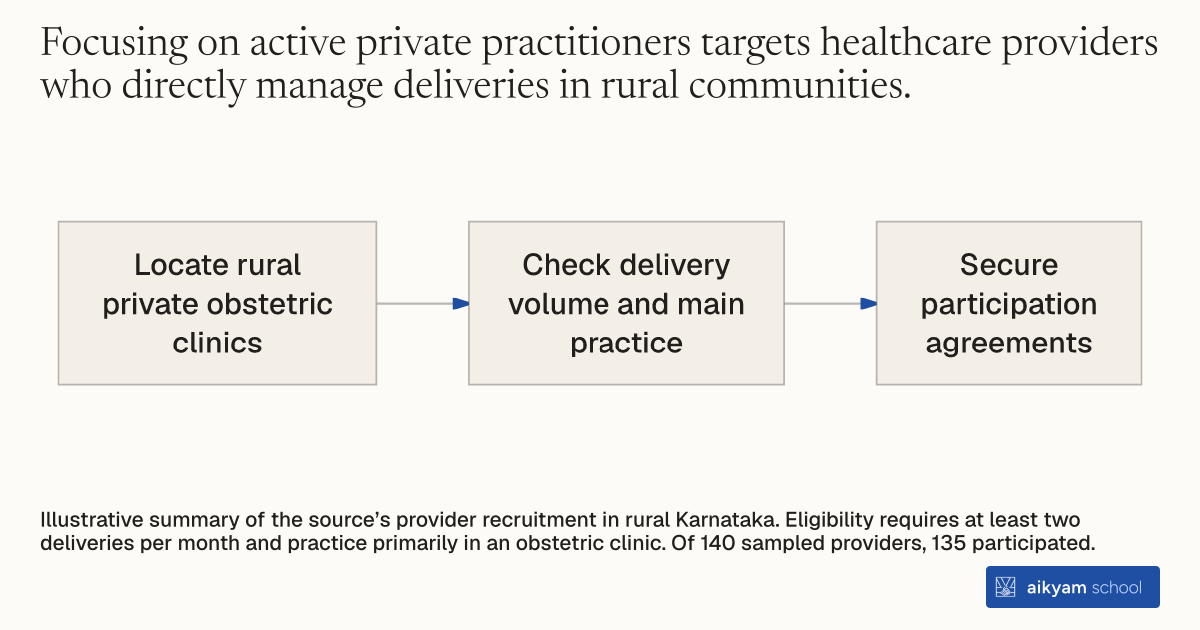
Recruit eligible obstetric providers
- Locate rural private obstetric clinics
- Check delivery volume and main practice
- Secure participation agreements
Illustrative summary of the source’s provider recruitment in rural Karnataka. Eligibility requires at least two deliveries per month and practice primarily in an obstetric clinic. Of 140 sampled providers, 135 participated.
See source →How
When to use
Rural health systems often suffer from poor maternal and neonatal outcomes despite high facility delivery rates. Program designers need to identify existing healthcare providers who manage birth deliveries in underserved communities. This method targets private obstetric care clinics in low-resource settings to improve maternal care quality.
Identify and recruit private obstetric care providers operating in rural regions with low quality maternal health indicators.
- Program managers survey health districts in rural Karnataka to locate private obstetric care clinics.
- Project teams filter clinics to select facilities conducting at least two deliveries per month.
- Field staff verify that target clinicians practice primarily in an obstetric care clinic.
- Administrative leads secure signed agreements from eligible health providers for program participation.
Why it works
Selecting clinicians with minimum delivery volumes ensures the intervention reaches patients at risk of delivery complications.
Example
Researchers identified and recruited private obstetric care providers conducting at least two deliveries per month in rural Karnataka, India, securing participation from 135 providers out of 140 sampled facilities.
About the study
Participants
140 rural healthcare providers sampled across rural Karnataka, India, with 135 participating providers and 2,895 surveyed mothers who recently gave birth.
Study Design
Randomized evaluation assigning private obstetric providers to input reward contracts (38 providers), output reward contracts (53 providers), or a control group with no incentives (44 providers).
Results
Enrolling 135 participating providers enabled testing of performance contracts that reduced postpartum hemorrhage rates by 20 to 23 percent across incentive groups.