Research design
Vary coverage of caregiver reminders
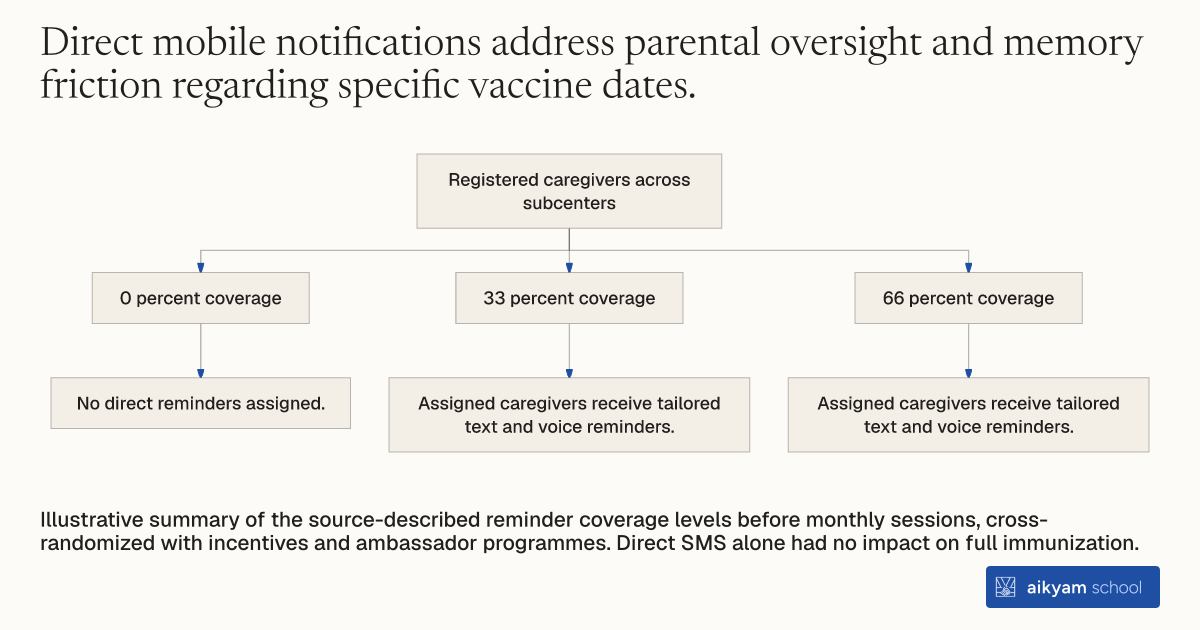
Registered caregivers across subcenters
- 0 percent coverage
- No direct reminders assigned.
- 33 percent coverage
- Assigned caregivers receive tailored text and voice reminders.
- 66 percent coverage
- Assigned caregivers receive tailored text and voice reminders.
Illustrative summary of the source-described reminder coverage levels before monthly sessions, cross-randomized with incentives and ambassador programmes. Direct SMS alone had no impact on full immunization.
See source →How
When to use
Caregivers in low-resource areas frequently forget upcoming clinic dates or default on late-stage child vaccines. Simple communication channels can deliver timely nudges directly to households. Deploy this method to transmit personalized text messages and automated voice calls to parents when child immunizations fall due.
Send automated text and voice call messages to registered caregivers to remind them of upcoming child vaccine clinic dates.
- Auxiliary nurse midwives collect each caregiver's mobile phone number during initial clinic registration.
- Health project software tracks upcoming immunization dates based on each child's registered profile.
- System operators set subcenter coverage targets to assign 0, 33, or 66 percent of caregivers to receive direct reminders.
- Program servers generate automated text messages and voice call notifications tailored to each child's specific due vaccine.
- Telecommunications platforms transmit the SMS and voice call reminders directly to assigned caregivers prior to local monthly immunization sessions.
Why it works
However, on their own, text reminders fail to overcome structural or motivational barriers unless paired with social ambassadors or incentives.
Example
In Haryana, India, researchers assigned caregivers across subcenters to receive text and voice call reminders for child vaccines, varying coverage levels between 0, 33, and 66 percent of caregivers.
About the study
Participants
Caregivers of children under twelve months of age across 140 primary health centers and 755 subcenters in seven districts of Haryana, India.
Study Design
A randomized controlled trial testing direct text and voice reminders at varied coverage levels (0, 33, or 66 percent) cross-randomized with incentives and ambassador programs.
Results
SMS reminders sent directly to caregivers had no impact on full immunization rates on their own compared to comparison villages, but served as a cost-effective complement when paired with community ambassadors or incentives.