Try, learn and adjust
Check justice-system referrals reach placements
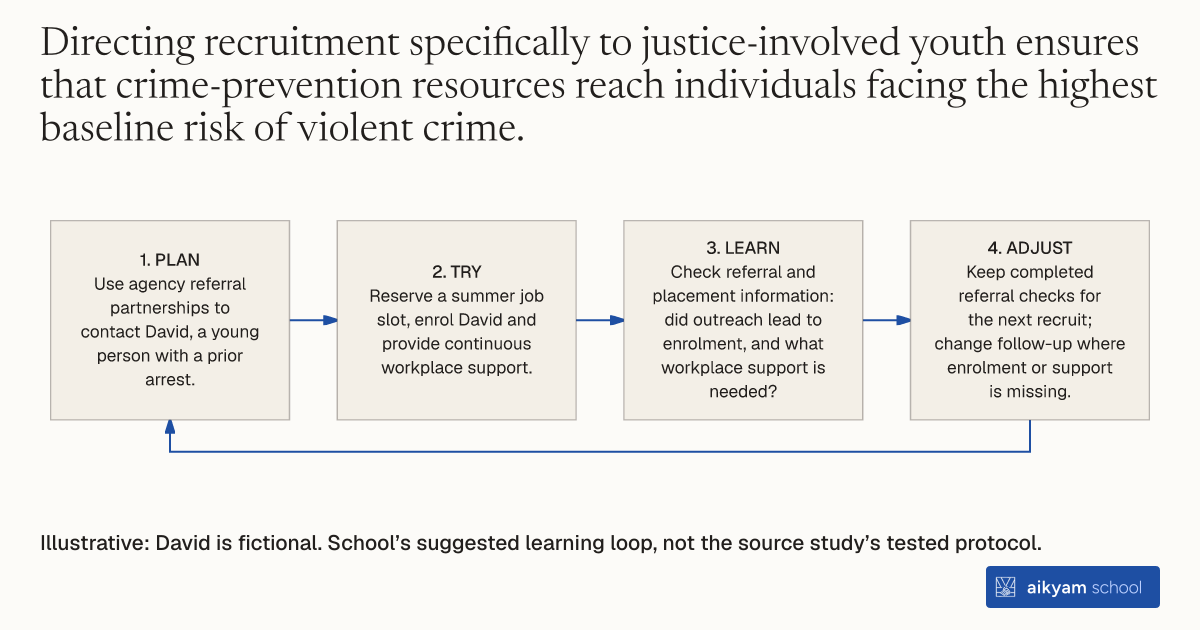
- Plan: Use agency referral partnerships to contact David, a young person with a prior arrest.
- Try: Reserve a summer job slot, enrol David and provide continuous workplace support.
- Learn: Check referral and placement information: did outreach lead to enrolment, and what workplace support is needed?
- Adjust: Keep completed referral checks for the next recruit; change follow-up where enrolment or support is missing.
Illustrative: David is fictional. School’s suggested learning loop, not the source study’s tested protocol.
See source →School’s suggested, untested learning loop. Observe referrals, enrolment and workplace support; referral alone is not the evaluated programme.
How
When to use
Disadvantaged adolescents with prior criminal justice involvement face exceptionally high risks of violent behavior and ongoing justice system contact. Standard open-application lotteries may fail to reach the highest-risk individuals who need intervention most. Targeted referral partnerships with juvenile justice agencies actively engage youth with prior arrests into structured summer employment.
Actively recruit justice-involved youth into summer employment programs through direct referral partnerships with criminal justice agencies.
- Partner with local law enforcement, juvenile probation, and criminal justice agencies to identify high-risk adolescents.
- Establish referral pipelines for youth with prior arrest histories.
- Target direct program outreach to referred individuals across urban school districts and neighborhoods.
- Reserve program slots to ensure justice-involved youth are directly enrolled in summer work placements.
- Provide continuous workplace support to help referred participants complete the program.
Why it works
Engaging high-risk participants maximizes the potential reduction in violent arrests.
Example
In the 2013 Chicago One Summer Chicago Plus program cohort, organizers directly recruited 41 percent of participants through referrals from the criminal justice system, contributing to a 35 percent overall reduction in violent crime arrests over the following year.
About the study
Participants
5,216 male youth ages 16–22 in Chicago across 2012 and 2013 cohorts (in 2012, 20% had prior arrests; in 2013, 47% had prior arrests and 41% were directly referred from the criminal justice system).
Study Design
Randomized Controlled Trial (RCT) evaluating One Summer Chicago Plus by assigning applicants (including justice system referrals) to treatment or control groups and tracking arrests across official police databases.
Results
OSC+ participation reduced violent crime arrests by 6.4 arrests per 100 youth over one year (a 35 percent reduction from a baseline of 18.3 arrests per 100 youth), with reductions persisting after the program ended.