Try, learn and adjust
Check eligible patients receive care without fees
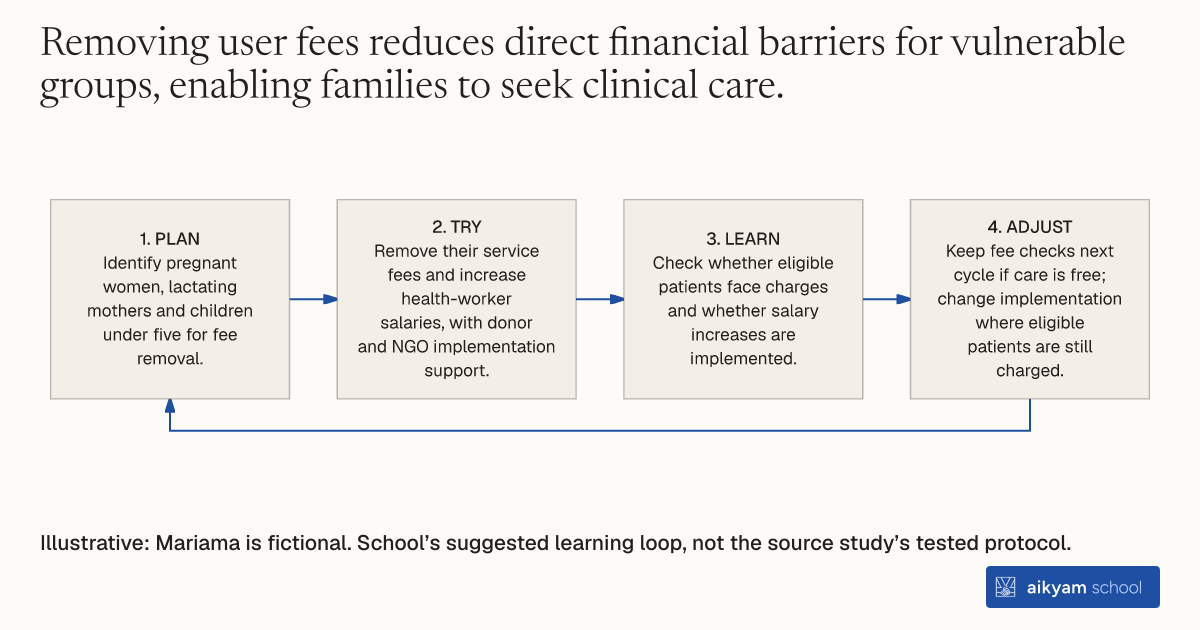
- Plan: Identify pregnant women, lactating mothers and children under five for fee removal.
- Try: Remove their service fees and increase health-worker salaries, with donor and NGO implementation support.
- Learn: Check whether eligible patients face charges and whether salary increases are implemented.
- Adjust: Keep fee checks next cycle if care is free; change implementation where eligible patients are still charged.
Illustrative: Mariama is fictional. School’s suggested learning loop, not the source study’s tested protocol.
See source →School’s suggested learning loop; not a tested source procedure. Observe patient charges and worker compensation. The source describes Sierra Leone’s 2010 policy, not an isolated trial of fee removal.
How
When to use
High maternal and child mortality rates often persist when health clinic user fees prevent vulnerable patients from seeking medical care. This method eliminates financial barriers to encourage pregnant women, lactating mothers, and young children to utilize essential healthcare services. It applies to national public health systems in low- and middle-income countries.
Remove point-of-care user fees for target vulnerable demographics while increasing health worker compensation.
- Identify high-priority health vulnerabilities including maternal and under-five child mortality across the national public healthcare system.
- Eliminate user fee charges for health services provided to pregnant women, lactating mothers, and children under age five.
- Increase baseline health worker salaries to offset lost user fee revenues and preserve provider motivation.
- Partner with international donors and non-governmental organizations to support health system implementation and monitoring.
Why it works
Pairing fee removal with increased health worker salaries maintains frontline provider motivation without relying on informal fee collection.
Example
In 2010, the Government of Sierra Leone launched a free health care initiative that removed user fees for pregnant women, lactating mothers, and children under age five while increasing health worker salaries.
About the study
Participants
254 government-run primary health clinics and 5,080 households in 508 communities across four districts in Sierra Leone.
Study Design
Randomized controlled trial context evaluating national policy changes alongside worker motivation interventions.
Results
The 2010 initiative removed user fees for pregnant women, lactating mothers, and children under age five while increasing health worker salaries across primary health clinics.