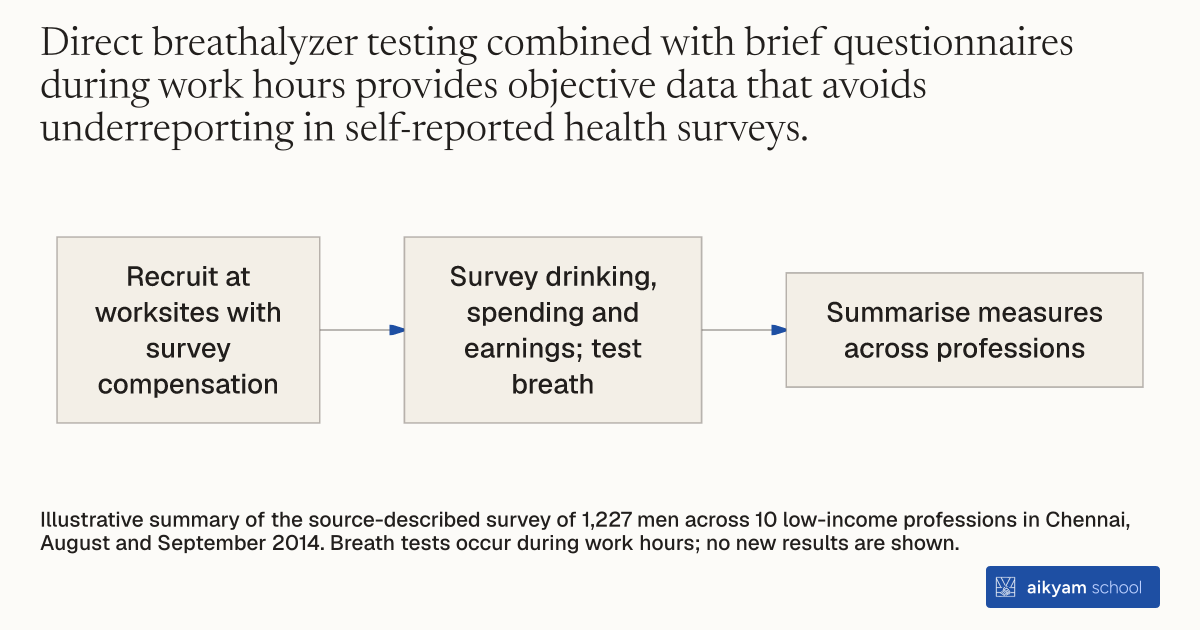
Research steps
Measure drinking during work hours
- Recruit at worksites with survey compensation
- Survey drinking, spending and earnings; test breath
- Summarise measures across professions
Illustrative summary of the source-described survey of 1,227 men across 10 low-income professions in Chennai, August and September 2014. Breath tests occur during work hours; no new results are shown.
See source →How
When to use
Organizations lack systematic data on alcohol consumption among working men in low-income settings. This diagnostic survey assesses daytime drinking frequency, daily alcohol spending, and on-the-job inebriation rates. Use this method to establish baseline alcohol consumption patterns and financial costs across manual labor professions.
Conduct a short diagnostic survey with working men during regular work hours to measure alcohol consumption patterns, spending, and daytime inebriation.
- Field surveyors identify adult working men across distinct low-income physical professions during work hours.
- Surveyors approach target individuals at their worksites and offer a small monetary compensation for answering a brief questionnaire.
- Surveyors administer a short survey recording alcohol consumption on the previous day, daily alcohol spending, and daily labor earnings.
- Surveyors perform a breathalyzer test on each respondent during work hours to measure blood alcohol concentration.
- Surveyors calculate the overall drinker prevalence, average drinks consumed, income shares spent on alcohol, and daytime inebriation rates across professions.
Why it works
Sampling across multiple low-income professions identifies specific occupations facing high risks of daytime drinking and alcohol-related financial strain.
Example
Field surveyors surveyed 1,227 men across 10 low-income professions in Chennai during August and September 2014. Overall, 76.1 percent reported drinking alcohol on the previous day, ranging from 37 percent among porters to 98 percent among sewage workers. Male drinkers reported consuming 3.8 to 6.5 standard drinks daily and spent 9.2 to 43.0 percent of their daily earnings of Rs 300 to Rs 500 on alcohol. Furthermore, 25.2 percent of the surveyed men tested positive for inebriation on breathalyzer tests conducted during regular work hours.
About the study
Participants
1,227 adult working men across 10 low-income manual professions in Chennai, India.
Study Design
Cross-sectional field survey with random intercepts during regular work hours combining self-reports and breathalyzer tests.
Results
76.1 percent of surveyed men drank alcohol on the previous day, consuming 3.8 to 6.5 standard drinks and spending 9.2 to 43.0 percent of daily income on alcohol, while 25.2 percent were inebriated during work hours.