Research procedure
Verify marital status after three years
- Recontact study couples after three years
- Update status; check marriage at baseline
- Compare dissolution by baseline preferences
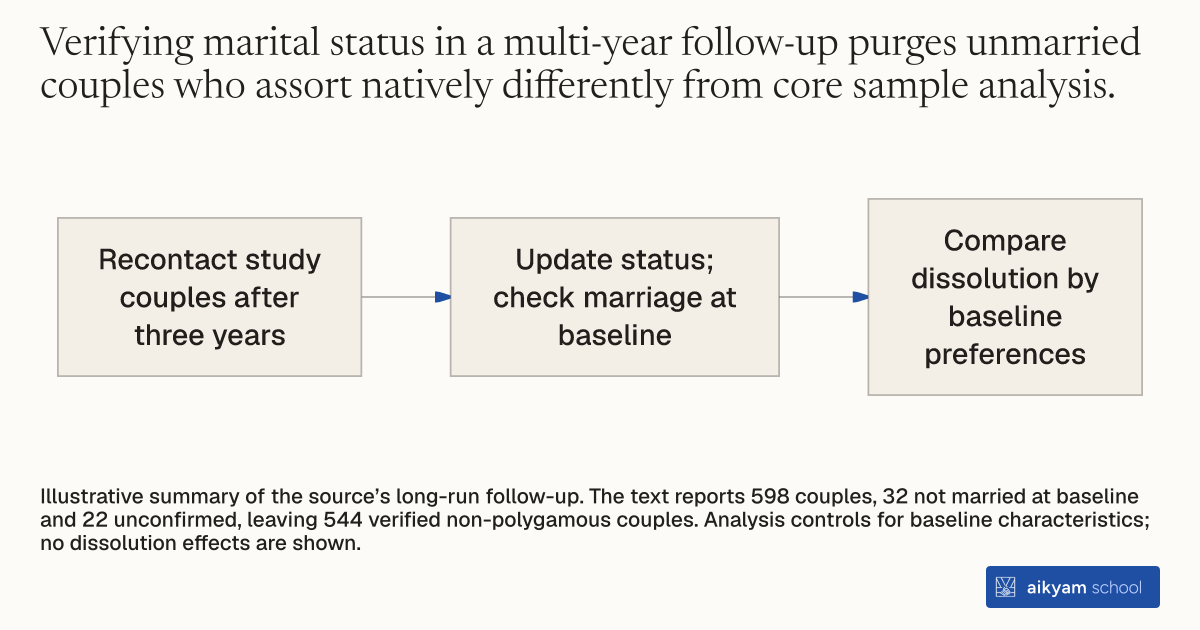
Illustrative summary of the source’s long-run follow-up. The text reports 598 couples, 32 not married at baseline and 22 unconfirmed, leaving 544 verified non-polygamous couples. Analysis controls for baseline characteristics; no dissolution effects are shown.
See source →How
When to use
In field experiments evaluating intrahousehold choices, researchers need to confirm true marital status and track long-run household stability. Initial sample recruitment may accidentally include cohabiting or false couples who respond differently to experimental incentives. Recontacting participants after three years verifies marital history and measures whether baseline preference heterogeneity predicts marital dissolution.
Recontact experimental participants three years post-intervention to verify marital status and evaluate long-run household outcomes.
- Recontact all participating study couples three years after initial experimental intervention sessions during a long-run follow-up study.
- Administer follow-up surveys to update and verify the marital status of each participant.
- Identify and drop couples who were not actually married at the time of initial field activities to prevent biasing initial estimates.
- Compare long-run separation and divorce rates between well-matched and poorly matched couples on baseline time preferences.
- Estimate regression models of marital dissolution controlling for baseline demographic, economic, and decision-making characteristics.
Why it works
Tracking marital stability tests whether baseline spousal preference heterogeneity imposes meaningful long-run welfare costs on households.
Example
In Western Kenya near Busia town, enumerators recontacted 598 couples three years post-intervention, successfully contacting over 96 percent and discovering that 32 couples (5 percent) were not actually married at baseline, while poorly matched couples were up to 9 percentage points less likely to still be married when controlling for observables.
About the study
Participants
598 participating couples in Western Kenya near Busia town, resulting in a verified sample of 544 non-polygamous married couples after dropping 32 false couples and 22 unconfirmed couples.
Study Design
Long-run follow-up survey recontacting study participants three years after the initial intervention to update marital status and analyze separation rates by baseline time preference match quality.
Results
Over 96 percent of couples were recontacted, 32 couples (5 percent) were identified as false couples not actually married at baseline, and poorly matched couples were 3 percentage points less likely to remain married without controls and over 9 percentage points less likely to remain married when controlling for observable characteristics.