Research demand test
Compare stove purchases at full and half price
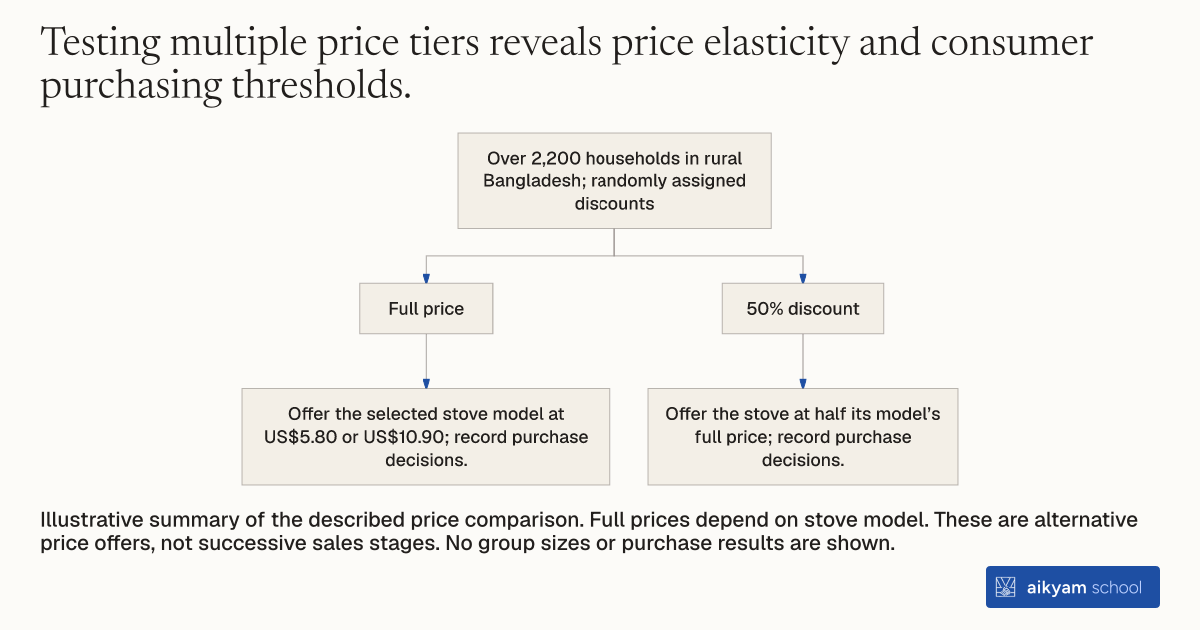
Over 2,200 households in rural Bangladesh; randomly assigned discounts
- Full price
- Offer the selected stove model at US$5.80 or US$10.90; record purchase decisions.
- 50% discount
- Offer the stove at half its model’s full price; record purchase decisions.
Illustrative summary of the described price comparison. Full prices depend on stove model. These are alternative price offers, not successive sales stages. No group sizes or purchase results are shown.
See source →How
When to use
Rural households in developing nations often show low adoption rates for new clean technologies. Program managers cannot gauge true market demand without testing consumer price sensitivity across cost barriers. Offering tiered price discounts allows evaluators to quantify household willingness to pay.
Measure household demand for new technologies by offering products at randomized price discount tiers.
- Select target technology models and set their full unsubsidized market prices, such as $5.80 or $10.90 per stove.
- Assign randomized price discounts, including a 50 percent discount tier, to participating households.
- Offer the products directly to households across target villages.
- Record final purchase decisions at each price point to measure adoption rates.
Why it works
This reveals whether upfront cost or baseline user preference forms the primary barrier to adoption.
Example
Researchers in rural Bangladesh offered over 2,200 households two cookstove models at full price ($5.80 or $10.90) and at a 50 percent discount to measure willingness to pay.
About the study
Participants
Over 2,200 households in rural Bangladesh.
Study Design
Randomized evaluation testing purchase adoption across full price and half price tiers.
Results
At full price ($5.80 or $10.90), 2 to 5 percent of households bought stoves, and a 50 percent discount increased purchases by 5 to 12 percentage points.