Try, learn and adjust
Check the half-family premium subsidy
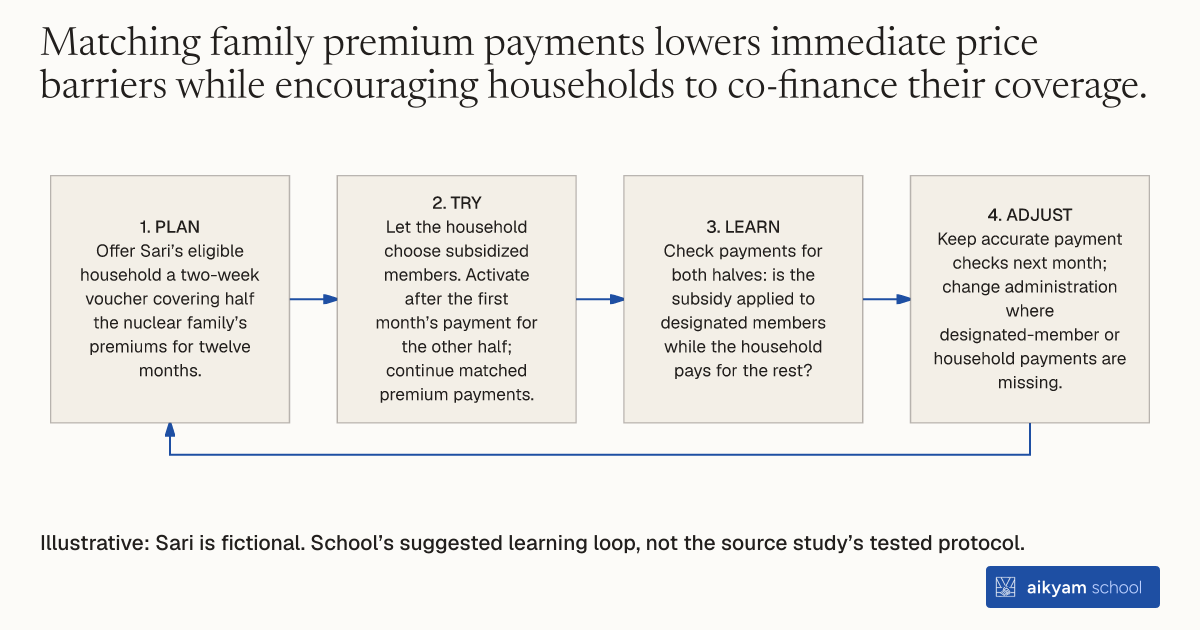
- Plan: Offer Sari’s eligible household a two-week voucher covering half the nuclear family’s premiums for twelve months.
- Try: Let the household choose subsidized members. Activate after the first month’s payment for the other half; continue matched premium payments.
- Learn: Check payments for both halves: is the subsidy applied to designated members while the household pays for the rest?
- Adjust: Keep accurate payment checks next month; change administration where designated-member or household payments are missing.
Illustrative: Sari is fictional. School’s suggested learning loop, not the source study’s tested protocol.
See source →School’s suggested, untested learning loop. Observe voucher timing, designated members and monthly payments; this check does not promise sustained coverage.
How
When to use
Uninsured informal-sector households often face low voluntary health insurance enrollment because paying full premiums for the whole family feels costly. Free subsidies can be expensive for governments to maintain, while offering no discount leaves enrollment low. A time-limited half subsidy structured as buy-one-get-one-free reduces household financial barriers while requiring family co-investment.
Offer a time-limited 50 percent annual premium discount to uninsured informal households by subsidizing half of the nuclear family members conditional on the household paying for the other half.
- Target uninsured, non-poor informal sector households who do not receive government health care subsidies for the poor.
- Issue a temporary voucher valid for two weeks that covers 100 percent of monthly health insurance premiums for half of the nuclear family members for twelve months.
- Assign the household to select which family members receive the free premium coverage.
- Require the household to pay the full monthly premium for the remaining half of non-subsidized family members for the first month to activate the subsidy.
- Provide automatic monthly subsidy payments for the designated covered members for twelve consecutive months while the household continues paying premiums for non-subsidized members.
Why it works
Restricting the voucher window to two weeks creates urgency and limits strategic delay in joining the health plan.
Example
Researchers offered a one-year 50 percent subsidy structured as buy-one-get-one-free to uninsured informal households in Medan and Bandung, Indonesia, requiring sign-up within two weeks. Over 12 months, the half subsidy increased enrollment by 10.0 percentage points above the status-quo control baseline of 7.8 percent. By month 20, coverage levels for the half-subsidy group converged to those of the control group as control group enrollment gradually increased.
About the study
Participants
5,996 uninsured non-poor informal sector households in Medan and Bandung, Indonesia.
Study Design
Multi-arm randomized controlled trial comparing 50 percent subsidies, 100 percent subsidies, and zero subsidies with administrative data tracking over 20 months.
Results
Year 1 enrollment increased by 10.0 percentage points (17.8 percent versus 7.8 percent in the control group). The mean number of household coverage months in Year 1 was 1.096 months for the half-subsidy group compared to 0.323 months in the control group.