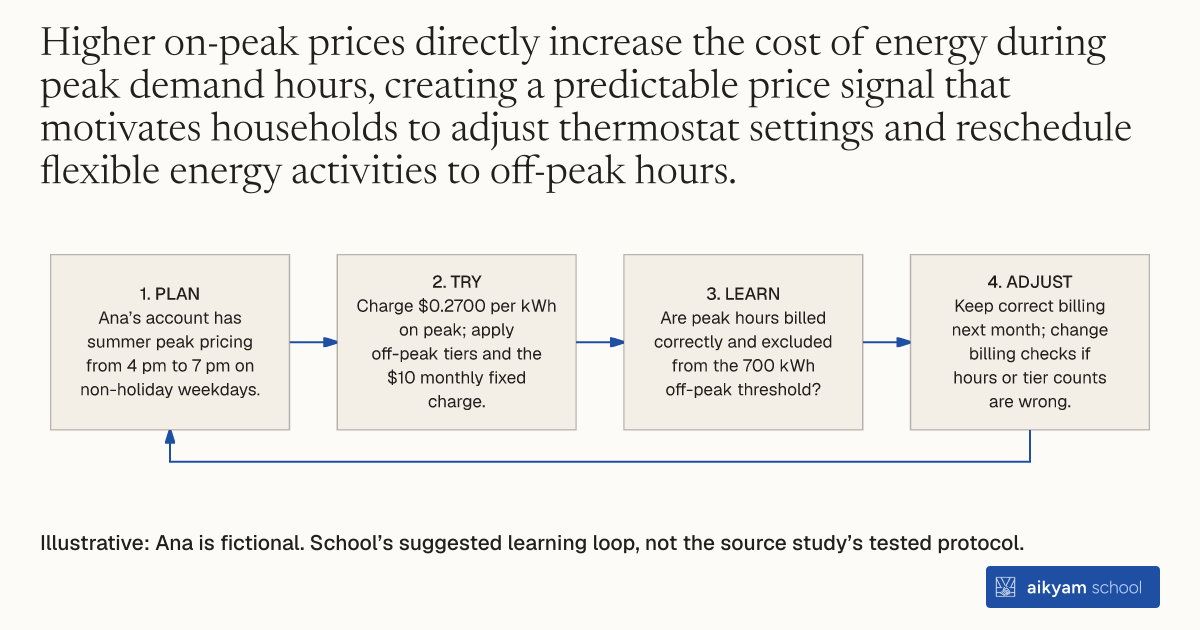
Try, learn and adjust
Check time-of-use bills follow the schedule
- Plan: Ana’s account has summer peak pricing from 4 pm to 7 pm on non-holiday weekdays.
- Try: Charge $0.2700 per kWh on peak; apply off-peak tiers and the $10 monthly fixed charge.
- Learn: Are peak hours billed correctly and excluded from the 700 kWh off-peak threshold?
- Adjust: Keep correct billing next month; change billing checks if hours or tier counts are wrong.
Illustrative: Ana is fictional. School’s suggested learning loop, not the source study’s tested protocol.
See source →School’s suggested learning loop, not a tested source procedure. Observe hourly use and charges from 1 June to 30 September. Off-peak rates are $0.0846 per kWh for the first 700 kWh and $0.1660 above.
How
When to use
Public utilities and energy planners need to incentivize load shifting during recurring summer afternoon peak demand hours. Standard flat electricity rates do not reflect dynamic daily marginal costs. A Time-of-Use rate schedule charges higher rates during predictable weekday peak hours to shift non-essential energy consumption to off-peak periods.
Design and implement a Time-of-Use pricing schedule for residential electricity consumption during summer months.
- Program administrators establish a peak pricing period from 4 PM to 7 PM on non-holiday weekdays from June 1 through September 30.
- Program administrators set the on-peak rate at $0.2700 per kWh during the 4 PM to 7 PM weekday peak window.
- Program administrators set the off-peak rate at $0.0846 per kWh for the first 700 kWh and $0.1660 per kWh for consumption exceeding 700 kWh during all non-peak hours.
- Billing systems maintain a standard $10 monthly fixed customer charge while excluding on-peak consumption from counting toward the 700 kWh off-peak tier threshold.
- Utility staff apply the TOU pricing schedule across all participating residential accounts automatically or upon opt-in enrollment throughout the summer season.
Example
SMUD implemented a Time-of-Use pricing schedule for residential customers in Sacramento, California during the summers of 2012 and 2013, charging $0.27 per kWh from 4 PM to 7 PM on weekdays, which reduced daily peak electricity usage by 0.287 kW per household among active opt-in joiners and 0.059 kW among passive consumers.
About the study
Participants
58,573 opt-in and 48,245 opt-out residential customer-hours in Sacramento, California.
Study Design
Randomized controlled trial comparing TOU opt-in encouragement and default opt-out enrollment against a standard rate control group.
Results
TOU enrollment reduced average daily peak electricity usage by 0.287 kW per household among active opt-in joiners (p < 0.01) and 0.059 kW among passive opt-out enrollees (p < 0.01) on regular non-event peak days, with active joiners' average monthly bills falling by $2.82.