Try, learn and adjust
Check weekly linear reward delivery
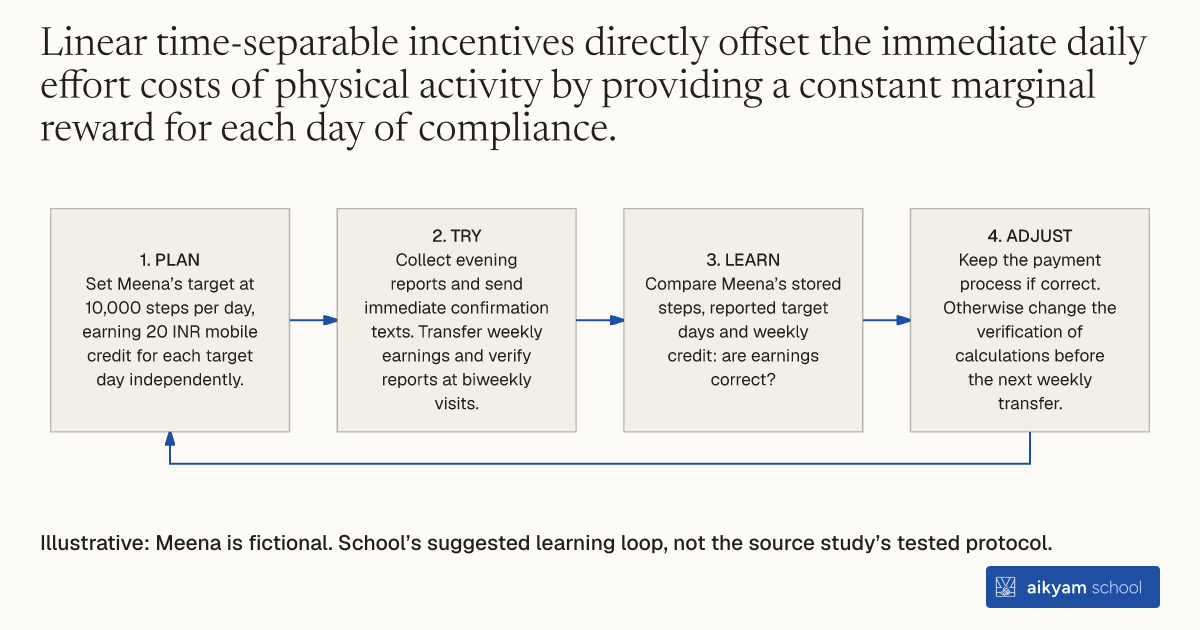
- Plan: Set Meena’s target at 10,000 steps per day, earning 20 INR mobile credit for each target day independently.
- Try: Collect evening reports and send immediate confirmation texts. Transfer weekly earnings and verify reports at biweekly visits.
- Learn: Compare Meena’s stored steps, reported target days and weekly credit: are earnings correct?
- Adjust: Keep the payment process if correct. Otherwise change the verification of calculations before the next weekly transfer.
Illustrative: Meena is fictional. School’s suggested learning loop, not the source study’s tested protocol.
See source →School’s suggested, untested loop: observe verified target days, confirmation texts and weekly credit; no impact claim follows.
How
When to use
Public health interventions aim to increase physical activity among individuals with chronic conditions who face immediate effort costs. Standard incentive designs offer linear rewards where each unit of compliance pays a fixed amount independently of performance on other days. This method serves adult patients managing diabetes through tracked daily exercise.
Provide daily linear financial rewards paid at regular intervals for achieving physical activity targets.
- Assign participants a fixed daily physical activity benchmark, such as walking 10,000 steps per day.
- Establish a linear compensation rate, paying a constant financial reward of 20 INR in mobile phone credits for every single day the target is achieved.
- Collect daily activity reports through an automated phone system where participants submit their step counts each evening.
- Issue an immediate automated text message after each daily report confirming compliance status, payment earned, and the scheduled transfer date.
- Transfer accumulated linear financial credits on a weekly schedule to the participant's prepaid mobile account.
- Verify daily self-reports against physical pedometer memory during biweekly home visits to ensure data accuracy.
Why it works
They offer a straightforward benchmark that motivates effort independently across days without requiring complex cumulative target calculations.
Example
Surveyors delivered weekly linear incentives of 20 INR per compliant day to 902 adults with diabetes or high blood sugar in Coimbatore, India. Participants increased their step-target compliance by 21.1 percentage points over monitoring, walking an additional 1,388 steps per day during the 12-week intervention.
About the study
Participants
902 participants in the Base Case linear incentive group (out of 3,192 total trial participants) in Coimbatore, India, with an average age of 49.56 years, 42 percent female, 67 percent diagnosed diabetic, and an average monthly household income of 16,000 INR.
Study Design
A randomized controlled trial comparing a weekly time-separable linear incentive contract (20 INR per day exceeding 10,000 steps) against a pedometer-only monitoring group across a 12-week intervention period, verified via biweekly pedometer data sync visits.
Results
Linear incentives increased daily step-target compliance by 21.1 percentage points and increased physical activity by 1,388 steps per day relative to monitoring, but required paying out rewards for 100 percent of compliant days.