Try, learn and adjust
Check photographs document staff presence
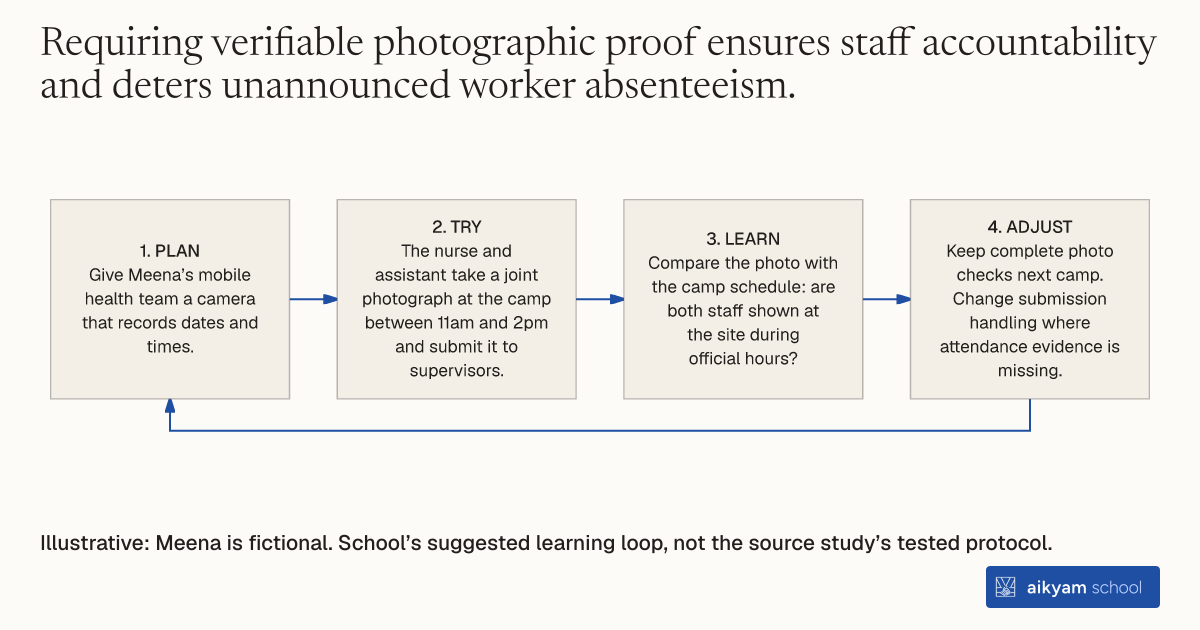
- Plan: Give Meena’s mobile health team a camera that records dates and times.
- Try: The nurse and assistant take a joint photograph at the camp between 11am and 2pm and submit it to supervisors.
- Learn: Compare the photo with the camp schedule: are both staff shown at the site during official hours?
- Adjust: Keep complete photo checks next camp. Change submission handling where attendance evidence is missing.
Illustrative: Meena is fictional. School’s suggested learning loop, not the source study’s tested protocol.
See source →School’s suggested, untested loop. Observe staff shown, photo dates and times, and submission. A photo documents presence; it does not establish health effects.
How
When to use
Public health clinics in rural areas suffer from chronic staff absenteeism and unpredictable facility closures. Unannounced health worker absences cause families to lose trust in local medical services. This method verifies and enforces health worker presence during scheduled mobile clinics in remote villages.
Verify health worker attendance at scheduled village camps using time-and-date-stamped digital photographs.
- Provide mobile immunization teams with cameras that record dates and time stamps on photographs.
- Require the attending nurse and assistant to take a joint photograph at the camp site.
- Record the photograph timestamp during official camp hours between 11 a.m. and 2 p.m.
- Submit timestamped photos to program supervisors to confirm camp operations.
Why it works
Reliable health worker attendance guarantees that advertised village camps open predictably on scheduled dates.
Example
Seva Mandir used time-and-date-stamped photos to document the presence of nurses and assistants across 30 mobile camp villages in Udaipur, India. This monitoring system verified that 95 percent of all planned immunization camps were conducted as scheduled.
About the study
Participants
134 rural villages in Udaipur, India, involving health staff serving local families.
Study Design
Clustered randomized controlled evaluation using time-stamped photo monitoring to document staff attendance across planned village camps.
Results
Time-stamped photo monitoring verified that 95 percent of the total planned immunization camps were conducted.