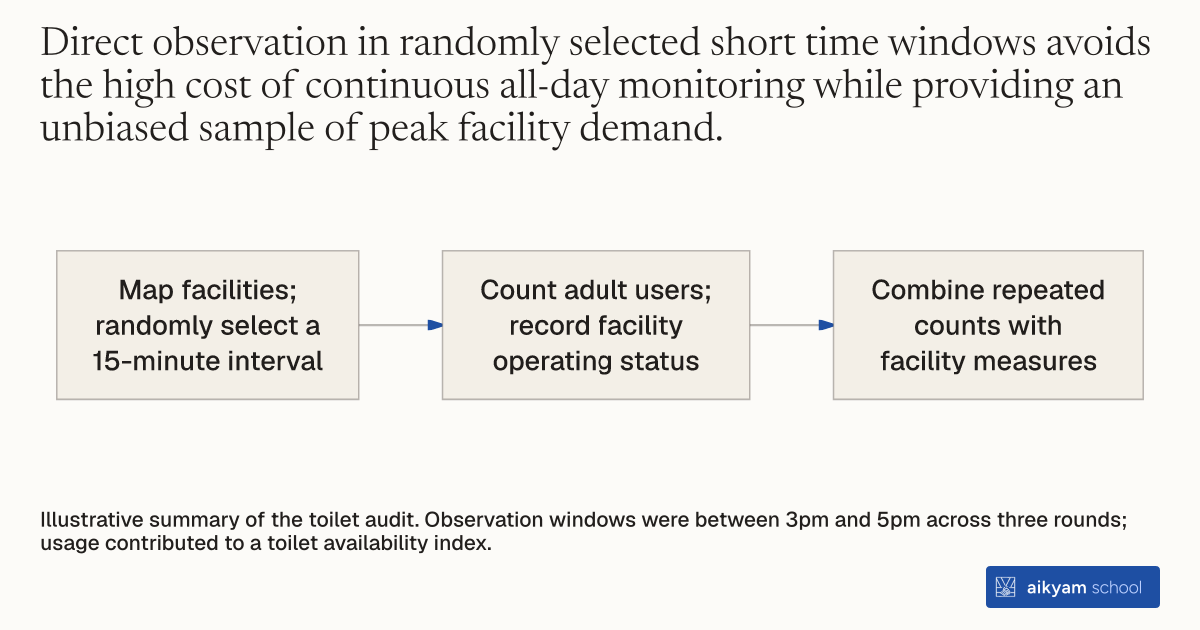
Research procedure
Count public toilet users
- Map facilities; randomly select a 15-minute interval
- Count adult users; record facility operating status
- Combine repeated counts with facility measures
Illustrative summary of the toilet audit. Observation windows were between 3pm and 5pm across three rounds; usage contributed to a toilet availability index.
See source →How
When to use
Measuring public toilet utilization in dense informal settlements is challenging because official attendance records and fee collection logs are rarely maintained or accurate. Self-reported citizen surveys often suffer from recall bias and social desirability bias regarding personal sanitation practices. Conducting unannounced, timed 15-minute observation counting blocks during peak usage hours provides an objective quantitative indicator of adult public toilet utilization.
Deploy enumerators to conduct timed observation counts of public toilet usage during peak afternoon hours.
- Map and index all public toilet facilities located across targeted slum settlements.
- Station trained field surveyors at each public toilet facility during afternoon operational hours.
- Select a randomly chosen 15-minute observation interval between 3:00 PM and 5:00 PM.
- Tally the exact number of adult users entering and utilizing the public toilet facility during the assigned 15-minute interval.
- Record the operational status of the toilet facility, distinguishing open structures from locked or non-functional units.
- Calculate the log of the mean number of adult toilet users across survey rounds to compile a standardized toilet availability index.
Why it works
Standardizing observation windows between 3:00 PM and 5:00 PM controls for diurnal usage variations across different slums.
Example
In Delhi, India, field surveyors conducted timed 15-minute user counts across three audit rounds covering 529 public toilet observations in 310 slums. The resulting adult user counts were combined with total and open toilet numbers to construct a slum-level toilet availability index averaging 0.935 standard deviations at baseline.
About the study
Participants
310 slums across 108 high-slum-density municipal wards in Delhi, India, with 529 slum-round public toilet observations across three audit rounds.
Study Design
Repeated cross-sectional field audits utilizing randomly selected 15-minute observation windows between 3:00 PM and 5:00 PM to count adult users at public toilets, integrated into a multi-variable toilet availability index.
Results
The 15-minute observation counts contributed to a composite toilet availability index that showed no statistically significant change (beta = -0.048, SE = 0.031) in response to private sanitation information disclosures sent to councilors.