Try, learn and adjust
Check town halls include deliberation and feedback
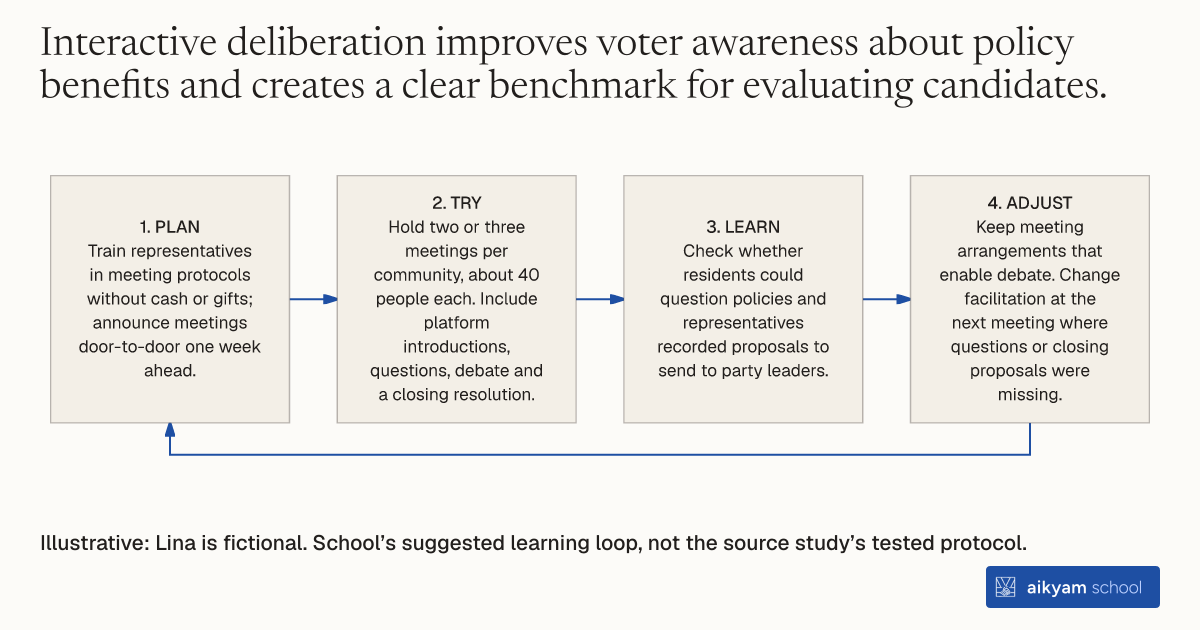
- Plan: Train representatives in meeting protocols without cash or gifts; announce meetings door-to-door one week ahead.
- Try: Hold two or three meetings per community, about 40 people each. Include platform introductions, questions, debate and a closing resolution.
- Learn: Check whether residents could question policies and representatives recorded proposals to send to party leaders.
- Adjust: Keep meeting arrangements that enable debate. Change facilitation at the next meeting where questions or closing proposals were missing.
Illustrative: Lina is fictional. School’s suggested learning loop, not the source study’s tested protocol.
See source →School’s suggested, untested loop: observe deliberation and feedback commitments. Meetings last 90 to 120 minutes; this check does not establish electoral effects.
How
When to use
A political party wants to persuade voters without relying on clientelism or cash gifts during an election campaign. Passive rallies and campaign leaflets often fail to engage citizens or communicate detailed legislative platforms effectively. Small deliberative town-hall meetings allow candidates to discuss policy platforms interactively with citizens in target communities.
Organize small deliberative town-hall meetings where party representatives discuss and debate policy platforms directly with voters.
- Instruct party nominees and officers on meeting protocols to ensure consistent platform communication without cash or gift distribution.
- Deploy advance teams of organizers door-to-door and in public areas one week before meetings to inform residents about the schedule and location.
- Host two or three town-hall meetings per targeted community with about 40 participants each.
- Open each 90 to 120 minute meeting with a 10 to 15 minute introduction explaining the electoral system and presenting the party platform.
- Conduct a 70 to 95 minute deliberation stage with multiple rounds of questions and participant debates regarding platform policies and proposed amendments.
- Conclude with a 10 minute resolution stage summarizing key proposals and committing representatives to transmit attendee feedback to party leaders.
Why it works
Discussing programmatic proposals directly with candidates persuades voters whose specific interests align with the party platform.
Example
Two national party-lists, Akbayan and Umalab Ka, implemented town-hall meetings across treatment barangays in the National Capital Region and Calabarzon in the Philippines before the May 2013 election. Meetings lasted between 90 and 120 minutes with around 40 attendees per session and no cash or gift distribution. Akbayan focused on pro-women reproductive rights legislation, while Umalab Ka focused on urban poor worker protections. The deliberative campaign increased Akbayan's vote share by 1.955 percentage points and Umalab Ka's vote share by 0.360 percentage points compared to control areas using standard rallies.
About the study
Participants
39 randomly selected barangays across 13 municipalities in the National Capital Region and Calabarzon region of the Philippines, involving 1,082 survey respondents and official precinct election results.
Study Design
Two-stage randomized field experiment assigning municipalities and barangays to either deliberative town-hall campaign treatment or business-as-usual control, using distance-based cluster resampling with a 1.5 kilometer buffer and within-municipality permutation tests.
Results
Town-hall meetings increased official party-list vote shares by 1.096 percentage points overall, representing a 46 percent increase over the 2.397 percent control baseline, and increased self-reported voting probability for the campaigning party by 13.48 percentage points.