Research steps
Follow people who move
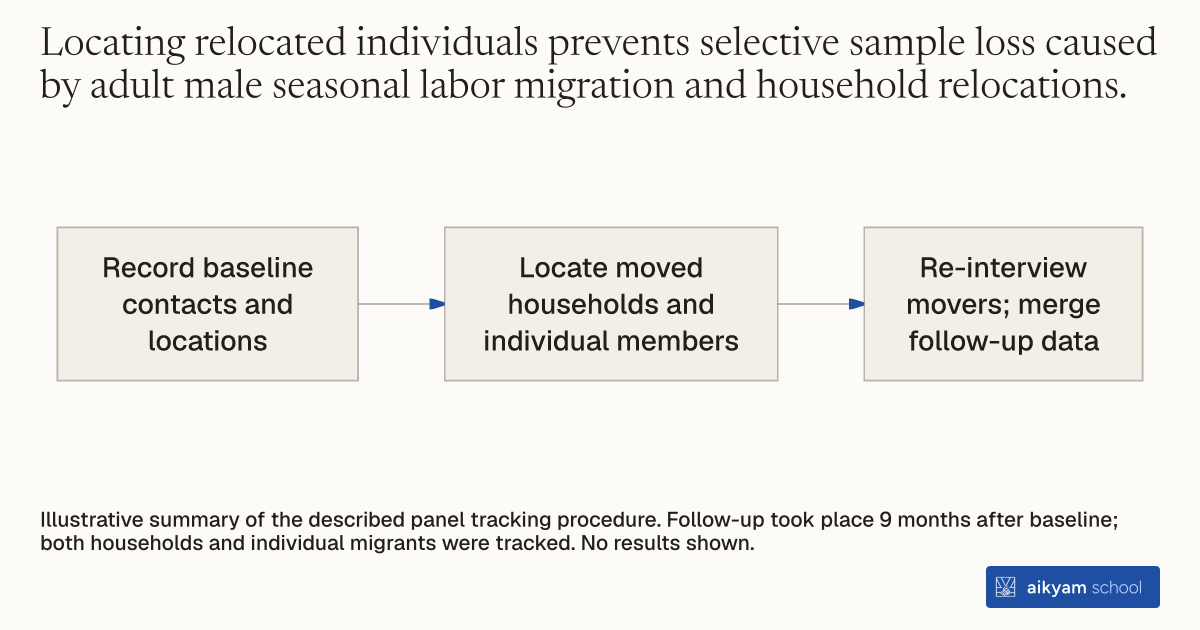
- Record baseline contacts and locations
- Locate moved households and individual members
- Re-interview movers; merge follow-up data
Illustrative summary of the described panel tracking procedure. Follow-up took place 9 months after baseline; both households and individual migrants were tracked. No results shown.
See source →How
When to use
Longitudinal evaluation studies in rural developing regions often suffer from high panel attrition due to seasonal and permanent migration. Losing relocated households or individual migrants introduces selection bias and reduces statistical power. Tracking both entire households and individual members who move between survey rounds maintains high panel retention.
Prevent panel survey attrition by following relocated households and individual migrants to their new residential locations.
- Record detailed baseline geographic coordinates, contact details, and local social network linkages for all sample households.
- Identify households and individual members who moved away from baseline communities prior to follow-up visits.
- Deploy specialized field survey teams to locate relocated individuals in their new destination communities.
- Administer the standardized follow-up panel questionnaire to tracked individual migrants and relocated households.
- Merge re-interviewed migrant data back into the main panel dataset to preserve complete sample representation.
Why it works
Maintaining comprehensive panel coverage eliminates attrition bias between treatment and control groups.
Example
During the 9-month follow-up survey of the Atención a Crisis evaluation in rural northwest Nicaragua, field survey teams tracked both entire relocated households and individual household members who had moved since baseline, keeping overall panel attrition down to 1.3 percent across 4,400 households.
About the study
Participants
4,400 households surveyed across 106 communities in 6 rural municipalities in northwest Nicaragua.
Study Design
Longitudinal panel survey conducted at baseline and 9-month follow-up across treatment and control communities, utilizing active individual tracking.
Results
Active tracking achieved a low 1.3 percent attrition rate in the second round, with attrition statistically uncorrelated with treatment status (regression coefficient of -0.004 with a standard error of 0.005).