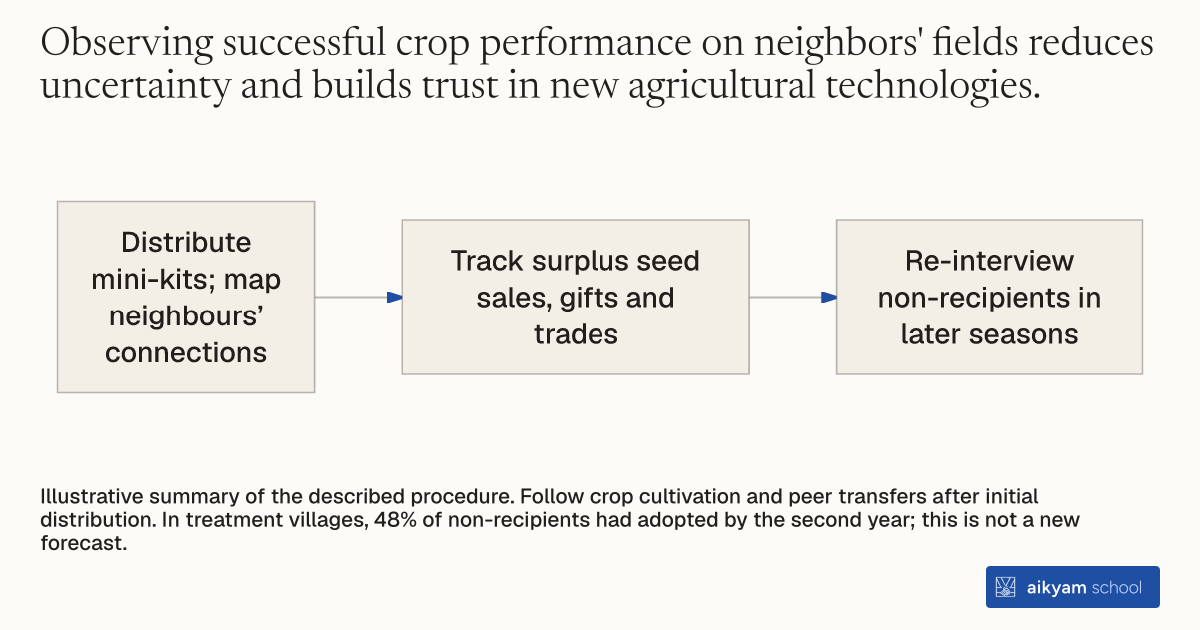
Research procedure
Follow informal seed exchanges
- Distribute mini-kits; map neighbours’ connections
- Track surplus seed sales, gifts and trades
- Re-interview non-recipients in later seasons
Illustrative summary of the described procedure. Follow crop cultivation and peer transfers after initial distribution. In treatment villages, 48% of non-recipients had adopted by the second year; this is not a new forecast.
See source →How
When to use
Centralized agricultural extension programs often fail to distribute climate-resilient seeds widely across rural areas. Relying exclusively on formal distribution channels slows technology adoption and leaves remote smallholders vulnerable to extreme weather. Tracking and leveraging informal social networks helps programs accelerate seed diffusion through local trading, gifting, and sharing.
Track and leverage informal social networks to measure and accelerate peer-to-peer crop technology diffusion.
- Extension agents distribute initial seed mini-kits to a designated subset of target farmers in target villages.
- Field staff survey neighboring non-recipient households to map baseline social and agricultural trading connections.
- Target farmers cultivate the new crop and generate surplus seed during the harvest season.
- Neighboring farmers observe crop performance and request surplus seed directly from target farmers.
- Target farmers transfer seed to peers through informal sales, gifts, or grain trades across local networks.
- Survey teams re-interview non-recipient households in subsequent seasons to track adoption rates and diffusion channels.
Why it works
Informal peer-to-peer exchanges bypass institutional distribution bottlenecks and lower transaction costs for surrounding smallholders.
Example
Researchers tracked seed diffusion across 64 treatment villages in Bhadrak and Balasore districts, Odisha, India. Within two years of initial mini-kit distribution to 5 farmers per village, 48 percent of non-recipient farmers adopted Swarna-Sub1 through informal peer network sharing and sales.
About the study
Participants
128 villages in Bhadrak and Balasore districts, Odisha, India; 64 treatment villages (5 mini-kit recipient farmers and 10 comparison non-recipients per village); 1,280 smallholders; 56 percent lived below the poverty line.
Study Design
Two-year randomized controlled trial tracking social network seed exchanges, direct market purchases, and peer-to-peer transfers between initial mini-kit recipients and non-recipients over two growing seasons (2011–2013).
Results
By the second year, 48 percent of non-recipient farmers in treatment villages had adopted Swarna-Sub1 through seed sharing, sales, and informal trades within their social networks, tripling the total adoption rate.