Research records
Vary campaign content and radio access
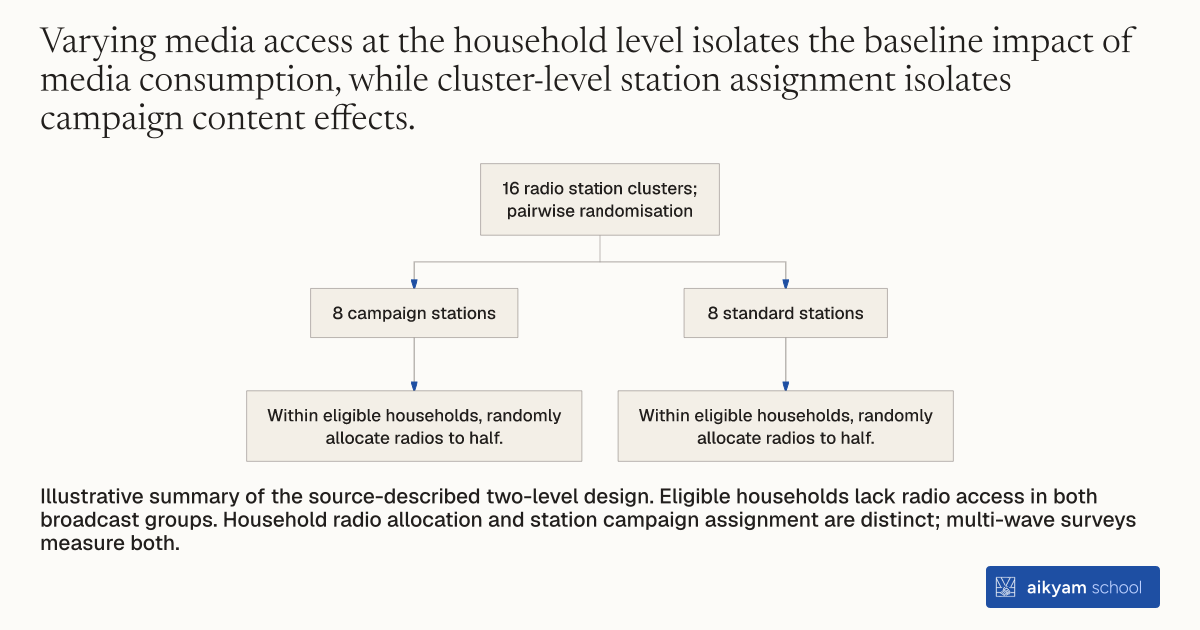
16 radio station clusters; pairwise randomisation
- 8 campaign stations
- Within eligible households, randomly allocate radios to half.
- 8 standard stations
- Within eligible households, randomly allocate radios to half.
Illustrative summary of the source-described two-level design. Eligible households lack radio access in both broadcast groups. Household radio allocation and station campaign assignment are distinct; multi-wave surveys measure both.
See source →How
When to use
In mass media and public health evaluations, researchers need to isolate the impact of overall media access from the impact of specific campaign content. Standard single-level evaluations cannot distinguish whether behavior shifts stem from broader media consumption or targeted health messaging. Combining cluster-level content randomization with household-level device distribution enables researchers to separate general media exposure effects from specific message persuasive impacts across large populations.
Combine cluster-level content randomization with household-level device allocation to evaluate macro campaign messaging and micro media exposure simultaneously.
- Select geographically and linguistically distinct media transmission clusters covering target evaluation populations.
- Pairwise randomize candidate media clusters into treatment stations broadcasting targeted campaign messaging and control stations continuing standard programming.
- Identify households lacking radio access across both treatment and control broadcast clusters during baseline field listings.
- Randomly allocate radio receivers to half of the eligible radio-deprived households within both treatment and control clusters.
- Collect multi-wave panel survey data from households with and without baseline radios to estimate independent micro and macro treatment effects.
Why it works
This double variation prevents confounding between general media habits and targeted campaign persuasive mechanisms.
Example
In Burkina Faso, evaluators deployed a two-level randomized design across 16 radio station clusters reaching 5.1 million people. Eight radio stations were randomly assigned to broadcast an intensive 2.5-year family planning campaign while eight maintained standard broadcasting, and 1,557 women in households lacking radios were randomly assigned to receive solar radios. This dual design revealed that general radio access reduced modern contraceptive use by 5.2 percentage points in control areas, whereas the campaign increased modern contraceptive prevalence by 5.9 percentage points overall.
About the study
Participants
7,515 women and 461 health clinics across 16 radio station clusters covering 5.1 million people in Burkina Faso.
Study Design
Two-level randomized trial combining pairwise cluster randomization of 16 radio stations with individual-level household radio distribution across 252 villages.
Results
General radio access in control areas decreased modern contraceptive use by 5.2 percentage points, whereas the intensive media campaign increased modern contraceptive prevalence by 5.9 percentage points (a 20 percent increase over the 29.5 percent control rate).