Research steps
Follow postal replies with telephone sampling
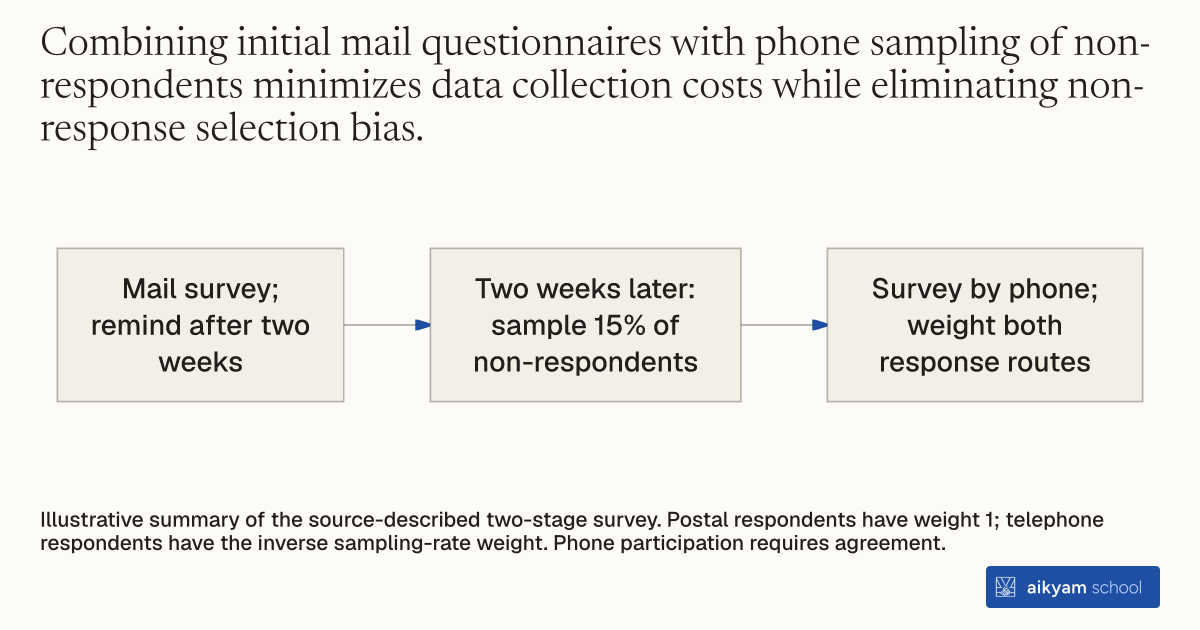
- Mail survey; remind after two weeks
- Two weeks later: sample 15% of non-respondents
- Survey by phone; weight both response routes
Illustrative summary of the source-described two-stage survey. Postal respondents have weight 1; telephone respondents have the inverse sampling-rate weight. Phone participation requires agreement.
See source →How
When to use
Evaluating health prevention programs among elderly populations often suffers from low questionnaire response rates and non-response selection bias. This method combines a broad mail survey with targeted phone follow-ups of non-respondents to measure risk perceptions and private investments. It is designed for researchers and public agencies seeking cost-effective data collection without compromising representative sample accuracy.
Conduct a two-stage survey combining low-cost postal mailings with targeted telephone sampling of non-respondents.
- Mail a written questionnaire simultaneously with program outreach materials to all targeted participants.
- Send a second copy of the mail questionnaire two weeks later to individuals who have not yet responded.
- Randomly select a 15% sample from the remaining non-respondent population two weeks after the second mailing.
- Call the sampled non-respondents by phone to administer the survey directly upon agreement.
- Apply sampling weights equal to 1 for postal respondents and the inverse of the sampling rate for telephone respondents to calculate unbiased population estimates.
Why it works
Weighting telephone responses enables researchers to achieve a high overall effective response rate across large study populations.
Example
In Île-de-France, CNAV mailed 40,670 questionnaires to program recipients and received 13,499 postal replies (33.2%), then sampled 4,075 non-respondents by phone to obtain 1,031 additional completes (25.3%), achieving a 50.1% overall response rate.
About the study
Participants
40,670 retired individuals with valid addresses living in Île-de-France (Paris region), France.
Study Design
Two-stage survey design featuring two postal waves followed by 15% phone sampling of non-respondents to collect data on perceived fall risks and financial barriers.
Results
The two-stage protocol increased the total response rate from 33.2% (postal only) to 50.1% overall, showing that 44.9% of retirees perceived no home fall risk and financial fear was a barrier for only 5.3%.