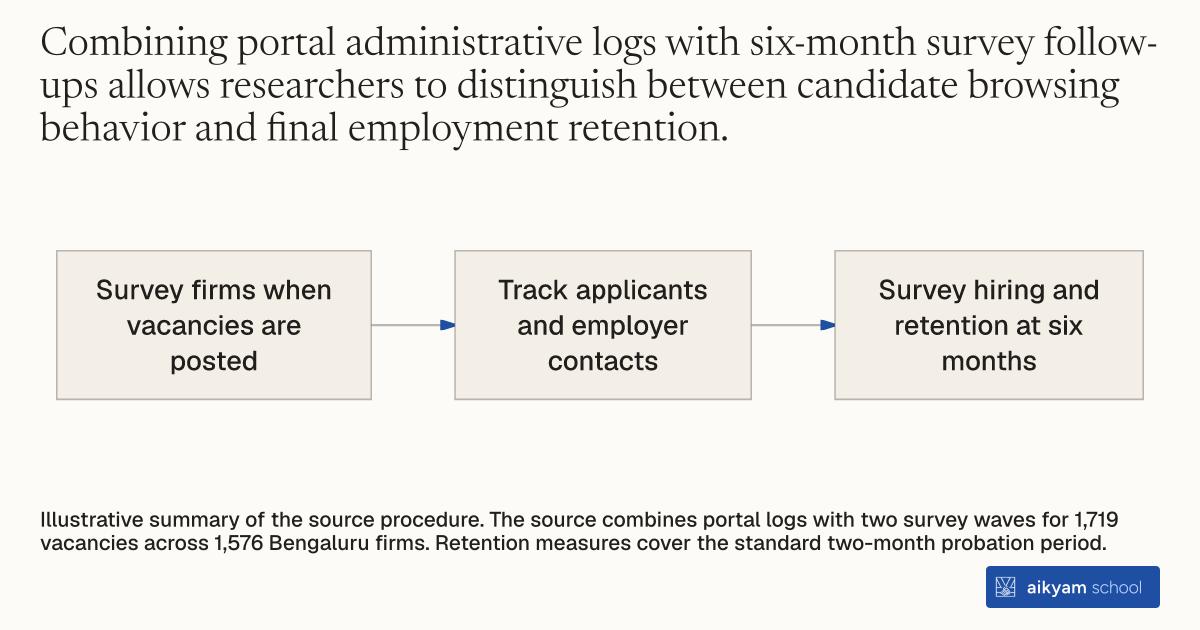
Research procedure
Track recruitment through six months
- Survey firms when vacancies are posted
- Track applicants and employer contacts
- Survey hiring and retention at six months
Illustrative summary of the source procedure. The source combines portal logs with two survey waves for 1,719 vacancies across 1,576 Bengaluru firms. Retention measures cover the standard two-month probation period.
See source →How
When to use
Evaluating recruitment interventions on digital labor platforms requires measuring both short-term employer engagement and long-term hiring outcomes. Platform usage data alone fails to capture whether candidate contacts lead to sustained employment. Combined administrative tracking and longitudinal firm surveys solve this by measuring total hires and retention across channels.
Measure recruitment outcomes and firm retention by pairing platform administrative logs with longitudinal employer surveys.
- Record initial firm characteristics, minimum wages, and recruitment requirements when vacancies are posted on the portal.
- Track platform administrative logs to record job posting visibility, applicant volume, and firm-initiated candidate contacts.
- Conduct a follow-up survey with participating firm managers six months after job vacancies are posted.
- Measure portal hiring rates, total vacancy fill rates, and employment retention following standard two-month probation periods.
- Compare hiring outcomes between intervention groups and comparison firms to evaluate treatment impact.
Why it works
This longitudinal approach captures whether digital recruitment expands total hiring or merely substitutes for informal referral networks.
Example
Researchers tracked 1,719 job vacancies across 1,576 firms on QuikrJobs in Bengaluru, India. Administrative data recorded applicant counts and employer outreach, while a six-month follow-up survey measured retention after the standard two-month probation period. The evaluation revealed that firms receiving combined advertising and verification services were 8 percentage points (68 percent) more likely to hire from the portal and 11 percentage points (73 percent) more likely to still employ their portal hire six months later.
About the study
Participants
1,719 job vacancies across 1,576 firms in Bengaluru, India.
Study Design
Two-wave firm survey (at posting and six months later) combined with portal administrative data tracking across a randomized controlled trial.
Results
Combination treatment increased candidate outreach by 147 percent (from 2.5 to 6.2 candidates), raised interview rates by 25 percent, increased portal hiring by 8 percentage points (68 percent), and increased portal employee retention after six months by 11 percentage points (73 percent).