Research procedure
Follow farmers over contrasting seasons
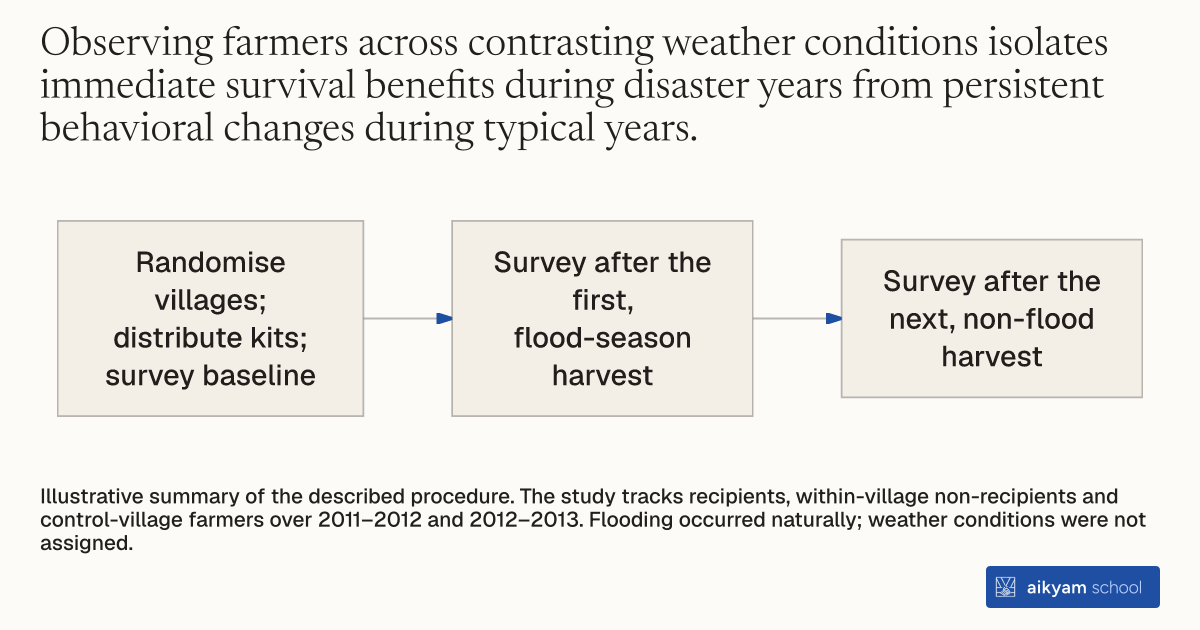
- Randomise villages; distribute kits; survey baseline
- Survey after the first, flood-season harvest
- Survey after the next, non-flood harvest
Illustrative summary of the described procedure. The study tracks recipients, within-village non-recipients and control-village farmers over 2011–2012 and 2012–2013. Flooding occurred naturally; weather conditions were not assigned.
See source →How
When to use
Evaluating climate adaptation technologies requires observing farmer behavior under both severe shock and normal weather conditions. Single-season studies fail to separate direct biological crop protection from long-term changes in farmer investments. This method helps agricultural researchers and policymakers measure the full economic and behavioral impacts of risk-reducing crop innovations on smallholders.
Evaluate agricultural technology impacts by conducting a two-season randomized trial that compares treatment and comparison households across naturally occurring shock and non-shock years.
- Research teams select flood-prone agricultural villages and randomly assign them to treatment and comparison groups.
- Field staff distribute treatment mini-kits containing improved seed and technical guidance to a subset of treatment farmers.
- Enumerators conduct baseline surveys across treatment mini-kit recipients, within-village non-recipients, and control village farmers.
- Survey teams conduct a first follow-up survey after the initial harvest season to measure immediate shock resilience and crop yields.
- Surveyors execute a second round of surveys after the subsequent non-shock harvest season to track persistent input investments, land cultivation, credit use, and informal seed sharing.
Why it works
Tracking multiple farmer cohorts across two seasons reveals how reduced risk perceptions drive long-term investments in fertilizer, land area, and transplanting techniques.
Example
Researchers from J-PAL and IRRI evaluated Swarna-Sub1 across 128 villages in Bhadrak and Balasore districts, Odisha, India, over the 2011 flood season and 2012 non-flood season. Tracking farmers across both years revealed that behavioral changes accounted for 41 percent of long-term yield gains and generated INR 2,969 per hectare in additional revenue.
About the study
Participants
128 villages in Bhadrak and Balasore districts, Odisha, India; 64 treatment villages (5 mini-kit recipient farmers and 10 comparison non-recipients per village) and 64 control villages (5 comparison farmers per village); 1,280 smallholders; 56 percent lived below the poverty line, 18 percent belonged to Scheduled Castes or Tribes, and average landholding was 0.84 hectares.
Study Design
Two-year randomized controlled trial tracking farmers over two growing seasons (2011–2012 flood year and 2012–2013 non-flood year) using structured household surveys administered after each harvest season.
Results
The two-season evaluation showed Swarna-Sub1 increased yields by 628 kg/ha during 10 days of flooding in 2011, maintained identical yield performance in non-flood 2012, increased average yields by 283 kg/ha across both years, and showed behavioral changes accounted for 41 percent of long-term yield increases.