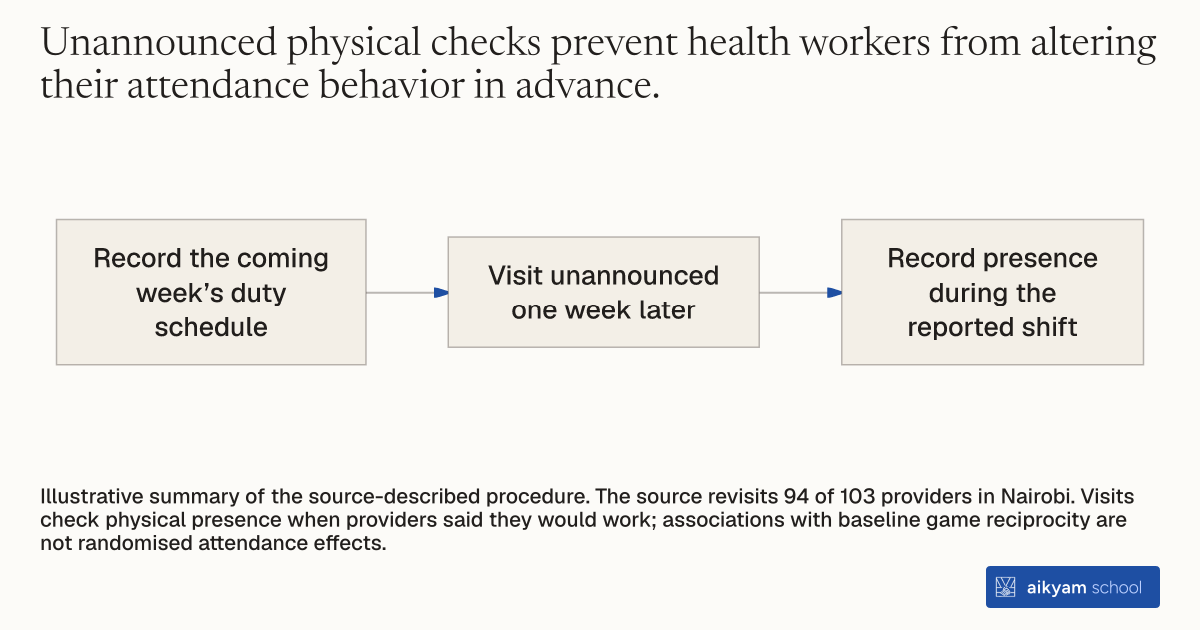
Research steps
Audit attendance against reported schedules
- Record the coming week’s duty schedule
- Visit unannounced one week later
- Record presence during the reported shift
Illustrative summary of the source-described procedure. The source revisits 94 of 103 providers in Nairobi. Visits check physical presence when providers said they would work; associations with baseline game reciprocity are not randomised attendance effects.
See source →How
When to use
Public health facilities in developing countries face high worker absence rates that degrade care quality. Standard self-reported schedules fail to give an accurate picture of actual worker attendance. This audit method uses unannounced physical facility visits to measure real-life provider absenteeism directly.
Conduct unannounced follow-up facility visits to measure actual health worker attendance at their assigned work times.
- Record each health worker's self-reported work schedule for the upcoming week during an initial survey or workshop session.
- Schedule a surprise follow-up audit to the primary facility during a day and time the health worker stated they would be on duty.
- Send field enumerators unannounced to the facility exactly one week after recording the schedule.
- Verify the physical presence or absence of each targeted health worker on site.
- Log attendance outcomes to construct objective facility absenteeism rates.
Why it works
Comparing actual physical presence against scheduled shifts provides an unbiased measure of real-world worker effort.
Example
In Nairobi, Kenya, researchers conducted surprise visits to primary health facilities to audit 94 health providers one week after a community workshop. Field enumerators found 44 percent of sampled health workers absent during their scheduled work shifts across public and private facilities.
About the study
Participants
94 health providers (re-visited out of 103 total participants) from public and private health centers and dispensaries in Nairobi, Kenya.
Study Design
Unannounced follow-up facility audits conducted one week after collecting self-reported duty schedules, comparing recorded physical presence against baseline experimental game reciprocity.
Results
Unannounced visits revealed a 44 percent overall provider absence rate (45 percent in public facilities, 40 percent in private facilities), and high baseline reciprocity in a Trust Game correlated with lower public worker absenteeism (38 percent absent for high-reciprocity workers vs 61 percent for low-reciprocity workers).