Try, learn and adjust
Check flat rewards match verified clinic visits
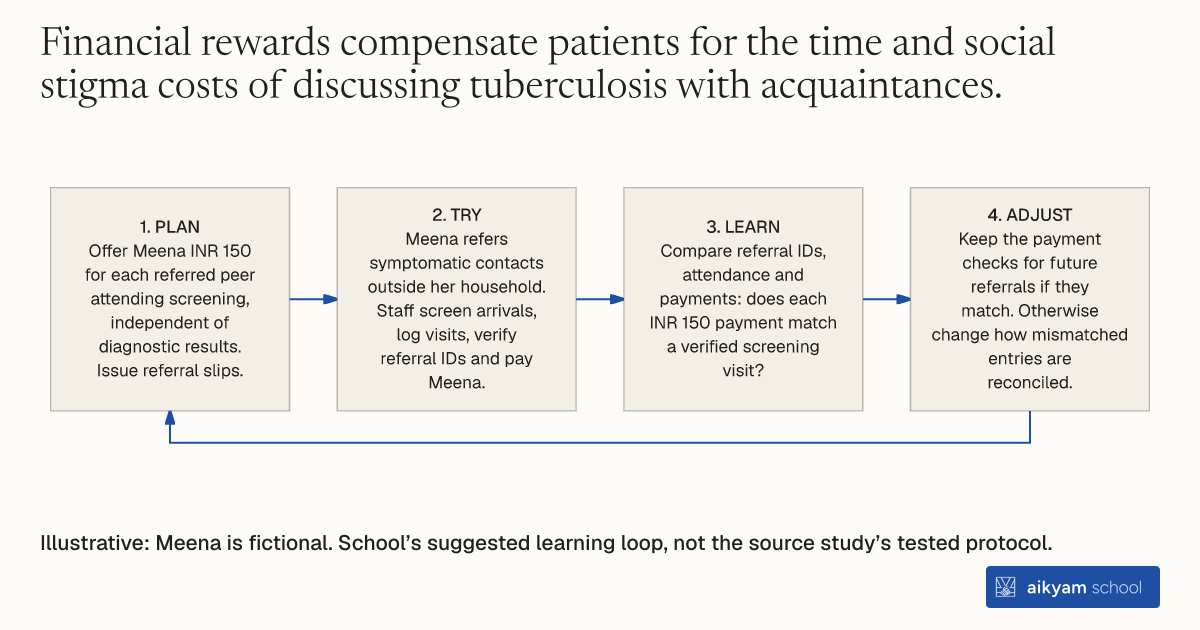
- Plan: Offer Meena INR 150 for each referred peer attending screening, independent of diagnostic results. Issue referral slips.
- Try: Meena refers symptomatic contacts outside her household. Staff screen arrivals, log visits, verify referral IDs and pay Meena.
- Learn: Compare referral IDs, attendance and payments: does each INR 150 payment match a verified screening visit?
- Adjust: Keep the payment checks for future referrals if they match. Otherwise change how mismatched entries are reconciled.
Illustrative: Meena is fictional. School’s suggested learning loop, not the source study’s tested protocol.
See source →School's suggested, untested loop: observe verified visits, IDs and flat payments. This is not a tested clinical protocol.
How
When to use
Current tuberculosis patients face social stigma and effort costs when contacting symptomatic peers for medical screening. Unconditional financial rewards compensate patients to overcome these social barriers and leverage their personal networks. Health programs offer flat payments per screening visit to motivate patients to refer symptomatic acquaintances.
Pay current tuberculosis patients a fixed financial incentive for every peer they refer who attends a health clinic for screening.
- Health workers explain to current tuberculosis patients at clinics that they will receive INR 150 for each referee who presents for screening.
- Health workers issue physical referral cards to patients for distribution to symptomatic contacts outside their households.
- Patients hand referral cards to symptomatic peers in their social networks and direct them to Operation ASHA centers.
- Referred individuals bring the cards to an Operation ASHA center where health workers conduct screening and log the visit.
- Health workers record the referee's arrival in referral registers and verify the patient ID linked to the referral card.
- Program staff disburse the unconditional payment of INR 150 to the referring patient upon confirmed clinic arrival.
Why it works
Providing flat monetary incentives encourages patients to share their network knowledge without depending on diagnostic test results.
Example
In India, researchers offered tuberculosis patients INR 150 per screened referee across 122 Operation ASHA centers, producing 0.096 new referrals per patient—more than twice the unrewarded rate—and finding 0.013 active cases per patient.
About the study
Participants
3,176 urban tuberculosis patients across 122 Operation ASHA centers in 10 Indian cities.
Study Design
Randomized evaluation testing unconditional rewards of INR 150 per screened contact against encouragement only and conditional rewards.
Results
Unconditional rewards produced 0.096 new referrals per patient (more than double the unrewarded rate) and led to 0.013 new active tuberculosis cases detected per patient.