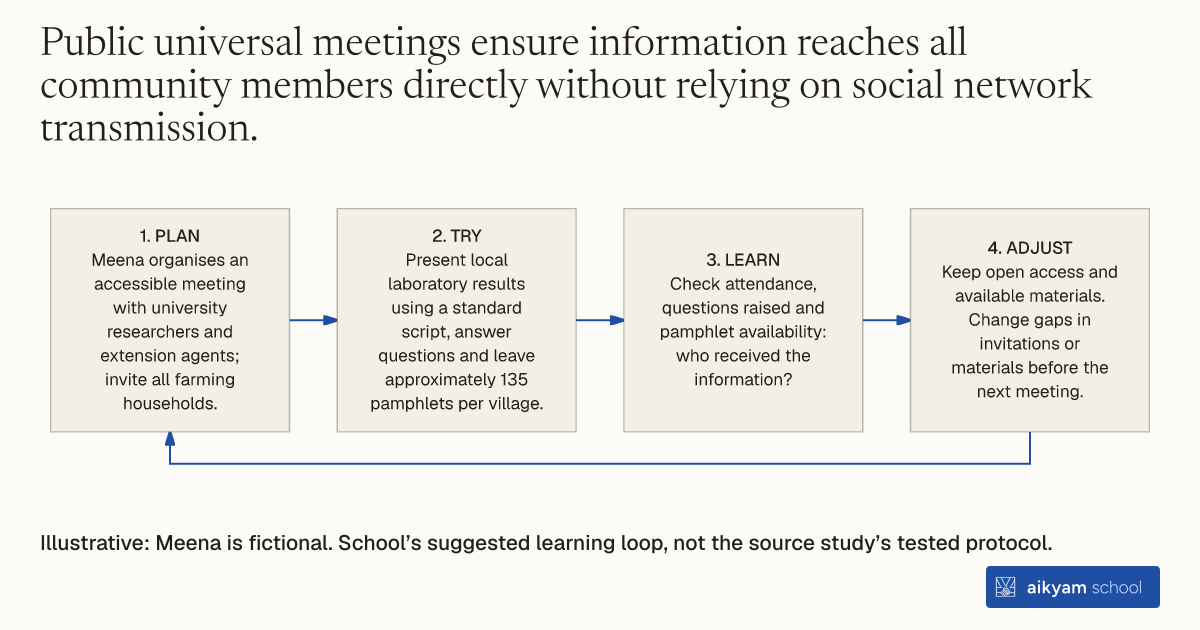
Try, learn and adjust
Check open village information sessions
- Plan: Meena organises an accessible meeting with university researchers and extension agents; invite all farming households.
- Try: Present local laboratory results using a standard script, answer questions and leave approximately 135 pamphlets per village.
- Learn: Check attendance, questions raised and pamphlet availability: who received the information?
- Adjust: Keep open access and available materials. Change gaps in invitations or materials before the next meeting.
Illustrative: Meena is fictional. School’s suggested learning loop, not the source study’s tested protocol.
See source →School’s suggested learning loop checks meeting reach and materials, separately from the tested village information intervention.
How
When to use
Smallholder farmers hold pessimistic misperceptions about input quality that prevent commercial input adoption. Information transmitted through contact farmers or informal social networks often decays or fails to reach disconnected households. Extension programmers use this method to deliver verified quality evidence universally to entire rural communities.
Organize open-attendance public information assemblies in rural villages using standardized scripts and local institutional presenters.
- Partner with trusted local agricultural university researchers and extension agents to organize public community assemblies.
- Select accessible central locations such as village administrative offices.
- Invite all village farming households to attend an open-attendance information session.
- Deliver a standardized presentation detailing laboratory test results for local market active nutrient content.
- Host open question-and-answer periods to address attendee queries regarding input quality across nearby markets.
- Distribute informational pamphlets to attendees, leaving approximately 135 pamphlets per village.
Why it works
Delivering site-specific laboratory results through trusted public institutions restores community confidence in local retail markets.
Example
University researchers and extension officers held public information meetings across treatment villages in Morogoro Region, Tanzania, sharing test results that local urea contained the required 46% nitrogen. Nearly all surveyed villagers attended the meetings, resulting in a 30% reduction in average quality concerns and a 27% increase in urea fertiliser adoption.
About the study
Participants
N = 995 farmers across 148 villages (74 treatment, 74 control) in Morogoro Region, Tanzania.
Study Design
Cluster-randomized controlled trial with universal village-level public meetings, standardized script presentation, and approximately 135 pamphlets distributed per treatment village.
Results
The village intervention decreased the average number of bad quality bags expected out of 10 by 0.595 (a 30% reduction, p < 0.01), increased the likelihood of purchasing urea by 10.6 percentage points (a 27% increase, p < 0.01), and increased fertiliser application by 5.65 kg per acre (a 46% increase, p < 0.05).