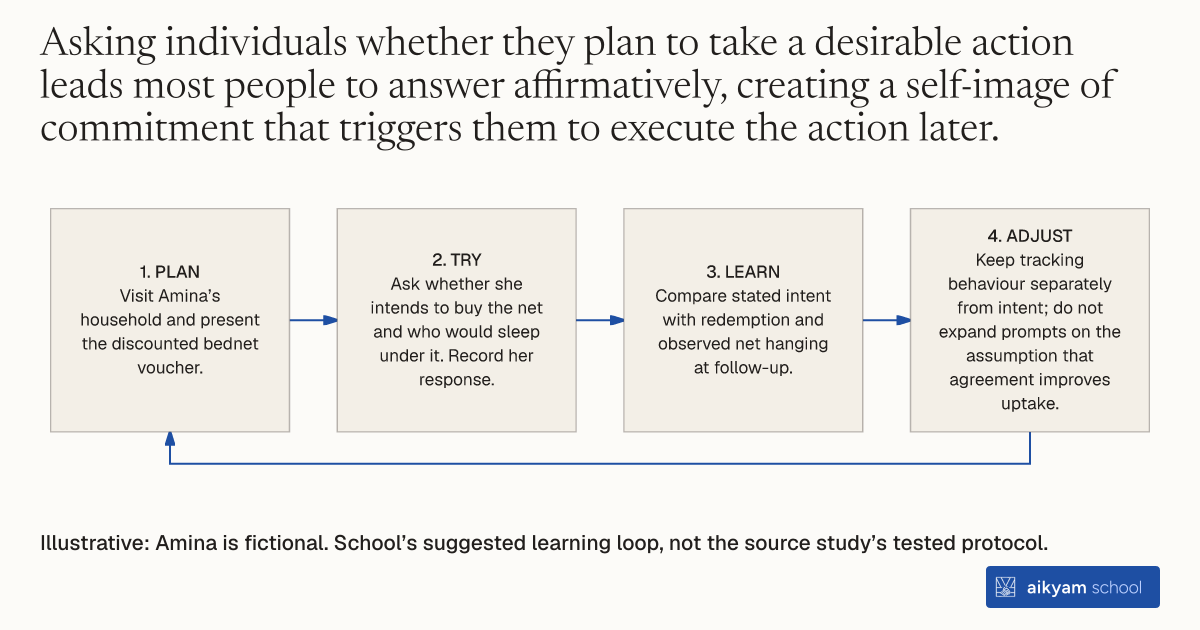
Try, learn and adjust
Check intentions against bednet purchase
- Plan: Visit Amina’s household and present the discounted bednet voucher.
- Try: Ask whether she intends to buy the net and who would sleep under it. Record her response.
- Learn: Compare stated intent with redemption and observed net hanging at follow-up.
- Adjust: Keep tracking behaviour separately from intent; do not expand prompts on the assumption that agreement improves uptake.
Illustrative: Amina is fictional. School’s suggested learning loop, not the source study’s tested protocol.
See source →School’s suggested loop, not a tested source procedure. Observe stated intentions, purchases and net hanging. The source found no significant effect of the prompt.
How
When to use
Rural households in developing countries frequently express intent to adopt health products but fail to follow through when purchasing items at local shops. Program managers use verbal commitment prompts based on self-perception theory to encourage follow-through on health decisions. This method targets household heads receiving discount vouchers for long-lasting bednets.
Elicit a direct verbal agreement from household heads when delivering promotional materials or vouchers to trigger self-perception mechanisms that favor follow-through.
- Send trained field staff to conduct in-person home visits with selected household heads.
- Present the household head with a purchase discount voucher for a long-lasting insecticide-treated bednet.
- Ask the household head directly whether they intend to buy the bednet using the voucher.
- Ask who in the family will sleep under the bednet after the household purchases it.
- Record the household head's verbal response and intent on the field survey form.
Why it works
Based on the foot-in-the-door technique, agreeing to an easy initial statement makes subsequent purchase execution more likely.
Example
Field staff in Western Kenya asked 613 rural households receiving bednet discount vouchers whether they intended to purchase the net and who would sleep under it, eliciting a positive verbal commitment from 92 percent of recipients.
About the study
Participants
613 households sampled across eight rural markets in Western Kenya, with an average household size of 7.43 members and $397 in assets.
Study Design
Randomized controlled trial comparing households asked for a verbal commitment at voucher delivery against a control group receiving vouchers without a commitment prompt, evaluated across 22 discount price levels.
Results
Verbal commitment had no statistically or economically significant effect on bednet take-up (coefficient 0.017, standard error 0.023) or on observed bednet hanging at follow-up (coefficient -0.040, standard error 0.050).