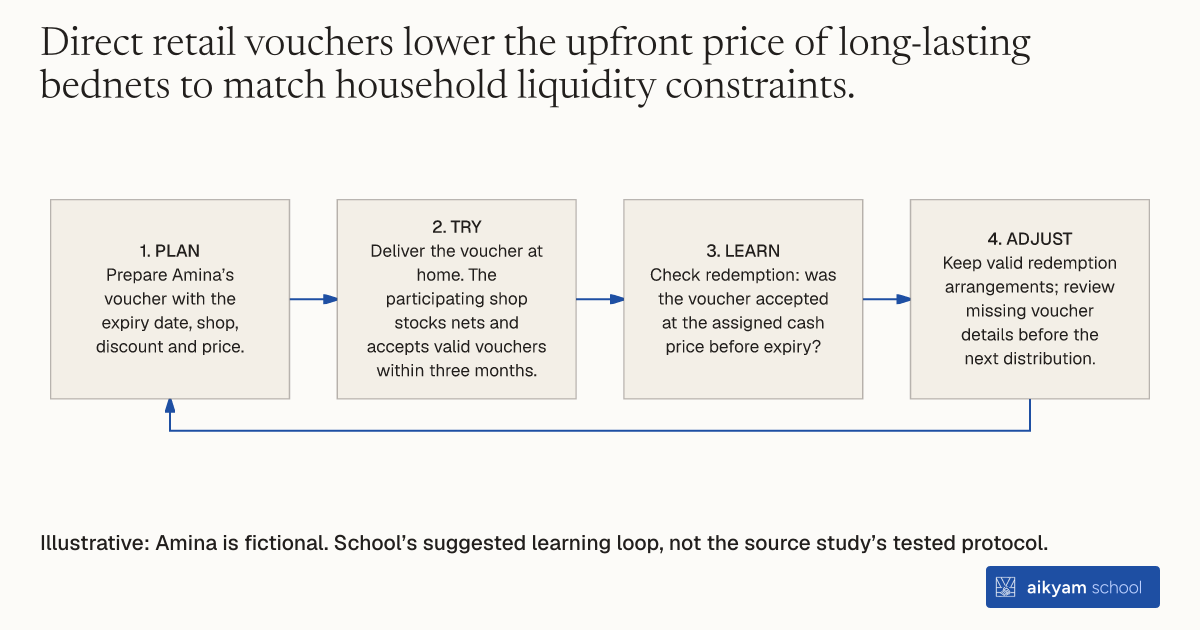
Try, learn and adjust
Check bednet voucher redemption
- Plan: Prepare Amina’s voucher with the expiry date, shop, discount and price.
- Try: Deliver the voucher at home. The participating shop stocks nets and accepts valid vouchers within three months.
- Learn: Check redemption: was the voucher accepted at the assigned cash price before expiry?
- Adjust: Keep valid redemption arrangements; review missing voucher details before the next distribution.
Illustrative: Amina is fictional. School’s suggested learning loop, not the source study’s tested protocol.
See source →School’s suggested loop, not a tested source procedure. Observe voucher details, redemption timing and assigned payments; do not assume net use.
How
When to use
Rural households in malaria-endemic areas face high mortality and morbidity risks from malaria. Free bednet distributions occur infrequently, leaving families without adequate coverage when existing nets wear out. Subsidized retail vouchers help poor families purchase long-lasting bednets at affordable discount prices through local shopkeepers.
Issue price-discounted bednet vouchers directly to households for redemption at nearby participating retail shops.
- Compile a list of target households from primary school registers in rural market areas.
- Visit each selected household at home to deliver a paper voucher for a long-lasting insecticide-treated bednet.
- Print the expiration date, local retail shop location, post-discount price, and discounted amount clearly on each voucher.
- Partner with one local retail shop per market area and supply the shopkeeper with blue, extra-large, rectangular long-lasting bednets.
- Require shopkeepers to collect valid vouchers and receive the assigned post-discount cash price from redeeming households within three months.
Why it works
A three-month redemption window gives cash-constrained families enough time to save funds for the discounted copayment.
Example
Field teams in Western Kenya distributed bednet vouchers with assigned discount prices ranging from 0 to 300 Kenyan shillings to 1,289 rural households across eight market areas, allowing families up to three months to redeem them at eight designated retail shops.
About the study
Participants
1,289 households sampled from school registers across eight rural markets in Western Kenya, averaging 7.43 members per household with $397 in average assets.
Study Design
Randomized controlled trial where households received vouchers assigned to subsidy levels between 40 percent and 100 percent (prices from 0 to 300 Ksh or US $0 to $4.60) redeemable at local shops within three months, followed by unannounced household inspection visits 2 to 15 weeks after redemption.
Results
Purchasing the net dropped by 35 percentage points when price increased from $0 to $1, and dropped another 25 percentage points when price increased from $1 to $2. Redemption time increased from 3 days for free nets to 35 days for nets priced at 70–90 Ksh, and to 54 days for the highest price group. Among households acquiring a net, 57.7 percent had the net hanging above a bed during unannounced follow-up visits.