Try, learn and adjust
Check understanding immediately after the health script
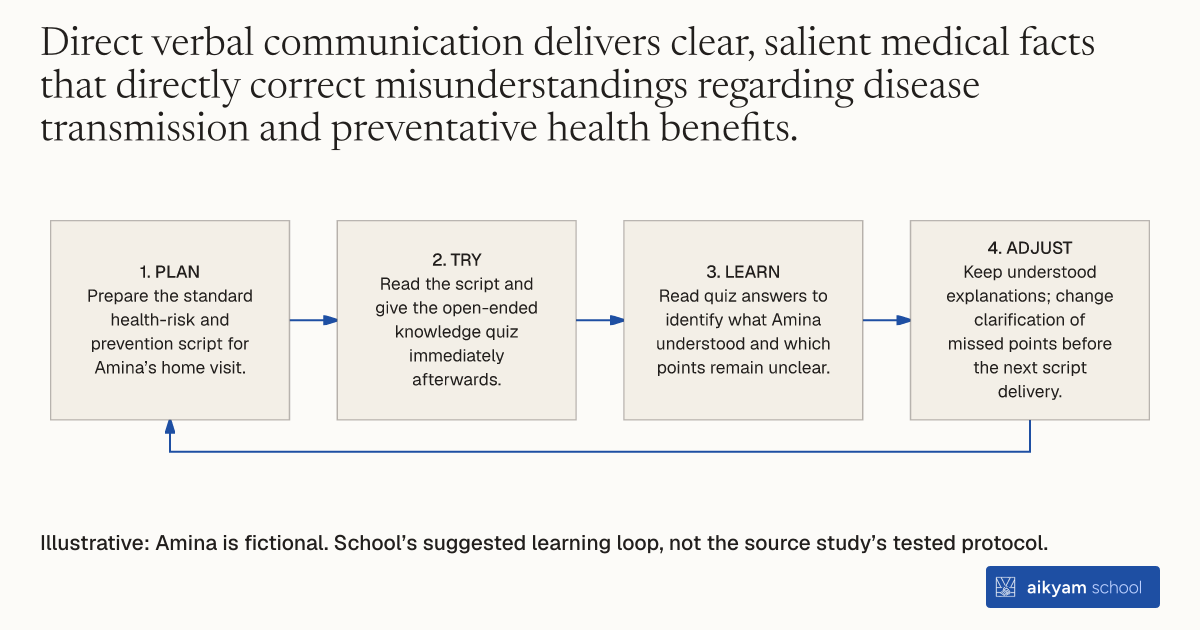
- Plan: Prepare the standard health-risk and prevention script for Amina’s home visit.
- Try: Read the script and give the open-ended knowledge quiz immediately afterwards.
- Learn: Read quiz answers to identify what Amina understood and which points remain unclear.
- Adjust: Keep understood explanations; change clarification of missed points before the next script delivery.
Illustrative: Amina is fictional. School’s suggested learning loop, not the source study’s tested protocol.
See source →Observe quiz responses separately from purchases. The source found knowledge gains without a statistically significant purchase effect. School suggests this learning loop; it was not tested by the source.
How
When to use
Low-income households in developing regions often lack detailed awareness regarding specific disease transmission risks and the preventive role of simple health products. Use this method when launching a community health intervention to educate families about infection hazards and proper usage of preventive technologies. It is intended for field teams seeking to improve health literacy among household decision-makers without relying on long or expensive educational courses.
Read a concise, structured health information script directly to household decision-makers during field visits to increase knowledge of disease risks and prevention strategies.
- A field officer visits target households at home during baseline survey rounds.
- The field officer reads a standardized verbal script detailing specific health risks, such as hookworm infection caused by walking barefoot or germs spread without soap.
- The script outlines the medical dangers of untreated infection, including severe anemia, growth retardation, and delayed cognitive development in children.
- The script presents practical prevention strategies, including wearing shoes, using pit latrines, and maintaining basic hygiene.
- The field officer administers an open-ended health knowledge quiz immediately following the reading to verify comprehension.
Why it works
However, while script reading successfully increases health knowledge, factual knowledge alone does not boost product purchases when financial or price constraints remain.
Example
In Western Kenya, field officers read an information script on hookworm transmission and shoe usage to 500 households during home visits. While the script raised immediate test scores by 34 percentage points and retention scores 3 months later by 24 percentage points, it produced no statistically significant change in shoe coupon redemptions compared to the control group.
About the study
Participants
999 surveyed households in Busia and Samia Districts of Western Kenya, living on roughly $1 per day, with 23% reporting child worm infections in the past year.
Study Design
Randomized controlled trial where half of the sampled households were randomly assigned to receive a verbal health information script cross-cut with randomized price discounts, cash payouts, and gender targeting.
Results
The script increased immediate health knowledge quiz scores by 34 percentage points (from a control mean of 29%) and follow-up scores 3 to 4 months later by 24 percentage points (from 37%), but had a statistically insignificant effect on shoe purchase (-2 percentage points, p > 0.10).