Try, learn and adjust
Check welfare records before confirming eligibility
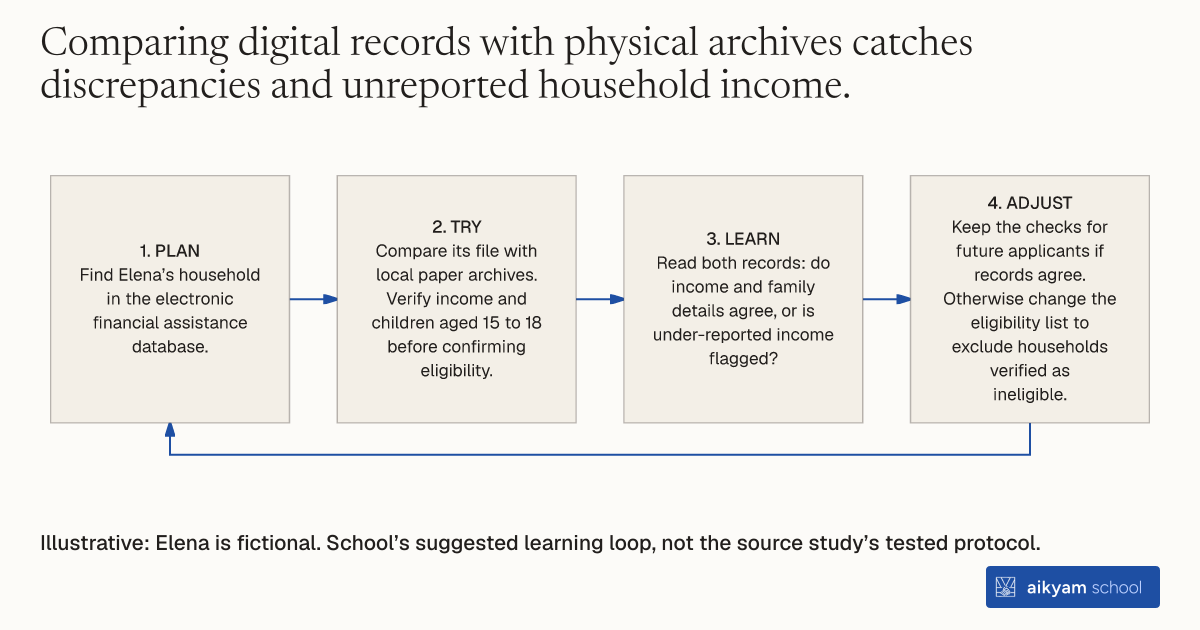
- Plan: Find Elena’s household in the electronic financial assistance database.
- Try: Compare its file with local paper archives. Verify income and children aged 15 to 18 before confirming eligibility.
- Learn: Read both records: do income and family details agree, or is under-reported income flagged?
- Adjust: Keep the checks for future applicants if records agree. Otherwise change the eligibility list to exclude households verified as ineligible.
Illustrative: Elena is fictional. School’s suggested learning loop, not the source study’s tested protocol.
See source →School’s suggested learning loop, not a source-tested procedure. Observe record discrepancies and verified eligibility; this check does not establish transfer effects.
How
When to use
Social protection programs must ensure cash transfers reach genuine low-income families while preventing fraudulent claims. Electronic databases can contain outdated records or unverified income data. Cross-referencing digital lists with physical welfare office archives verifies eligibility for poor households with secondary school-aged children.
Verify welfare recipient eligibility by cross-referencing electronic financial assistance databases with local paper archives.
- Extract household records from the central electronic database of financial assistance recipients.
- Cross-check electronic files against hard-copy physical archives at local Social Welfare Centres.
- Identify Social Financial Assistance recipient households with children aged 15 to 18.
- Verify household income levels and flag fraudulent under-reporting of income.
- Exclude non-qualifying or ineligible households from the final list of potential program beneficiaries.
Why it works
This audit process ensures that limited social protection resources reach verified low-income families.
Example
The Ministry of Labour and Social Policy in Macedonia compiled an electronic database of welfare recipients in summer 2010. Staff checked these digital files against physical archives at Social Welfare Centres, identifying 12481 eligible Social Financial Assistance households with children aged 15 to 18 years old.
About the study
Participants
1053 households with children aged 14 to 18 sampled at baseline across 84 municipalities in Macedonia, with 830 households followed up after two years. Households averaged 4.5 members and 55 percent were Muslim.
Study Design
A randomized trial across all 84 municipalities in Macedonia, stratified by population size into 42 mother-recipient municipalities and 42 household-head-recipient municipalities. Evaluation surveys collected baseline data in 2010 and follow-up data in 2012.
Results
Verification identified 12481 eligible SFA households with secondary school-aged children. Program evaluation showed a 72 percent overall take-up rate, and targeting cash transfers to mothers increased the household budget share spent on food by 4 to 5 percentage points.