Research steps
Construct a vote-switching proxy
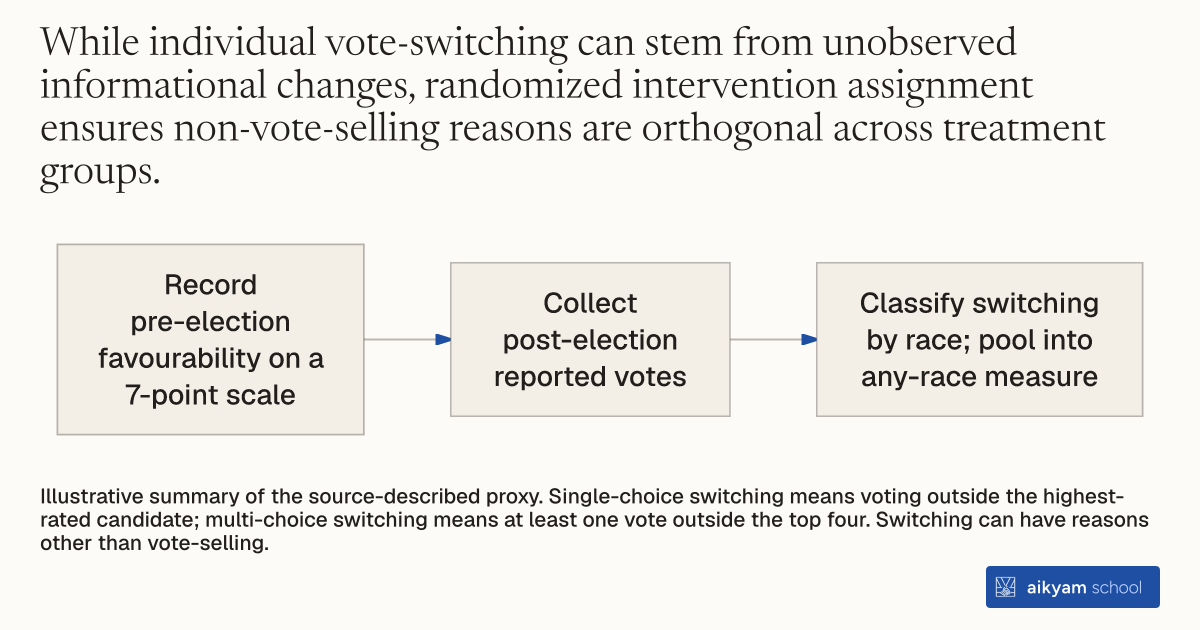
- Record pre-election favourability on a 7-point scale
- Collect post-election reported votes
- Classify switching by race; pool into any-race measure
Illustrative summary of the source-described proxy. Single-choice switching means voting outside the highest-rated candidate; multi-choice switching means at least one vote outside the top four. Switching can have reasons other than vote-selling.
See source →How
When to use
Researchers and civil society organizations studying vote-buying face secret ballots where direct observation of vote-selling is impossible. This proxy method measures vote-selling indirectly by tracking changes between pre-election preferences and post-election reported choices. It applies to electoral studies in secret-ballot jurisdictions where clientelism and candidate cash offers occur.
Construct a vote-switching outcome metric by comparing voters' pre-election candidate favorability ratings with their post-election reported votes across two survey waves.
- Enumerators conduct a baseline survey during the month prior to an election, asking voters to rate all candidates in each race on a 7-point favorability scale.
- Enumerators administer a post-election survey within a month following the election to record for whom participants actually voted.
- Analysts classify single-choice race voters as having switched if they voted for a candidate other than their highest-rated baseline candidate.
- Analysts classify multi-choice race voters as having switched if they voted for at least one candidate outside their top four baseline choices.
- Analysts pool switching indicators across all targeted electoral races to form a composite binary variable indicating vote-switching in any race.
Why it works
Consequently, treatment-induced changes in vote-switching isolate changes in actual vote-selling behavior.
Example
In Sorsogon City, Philippines, researchers evaluated 883 voters across mayoral, vice-mayoral, and city council races during the May 2013 municipal elections, finding 56% switched votes in at least one race.
About the study
Participants
883 surveyed voters across three municipal races in Sorsogon City, Philippines in the May 2013 elections.
Study Design
Two-wave panel survey field experiment measuring vote-switching across single-seat and multi-seat elections, validated against candidate favorability gaps and enumerator vote-buying ratings.
Results
Overall 56% of voters switched in at least one race (12% mayor, 22% vice-mayor, 44% city council); a one-category increase in favorability gap reduced switching by 13 percentage points, while a one-point increase in candidate vote-buying gap increased switching likelihood by 23%.