Research procedure
Randomise shared water pools together
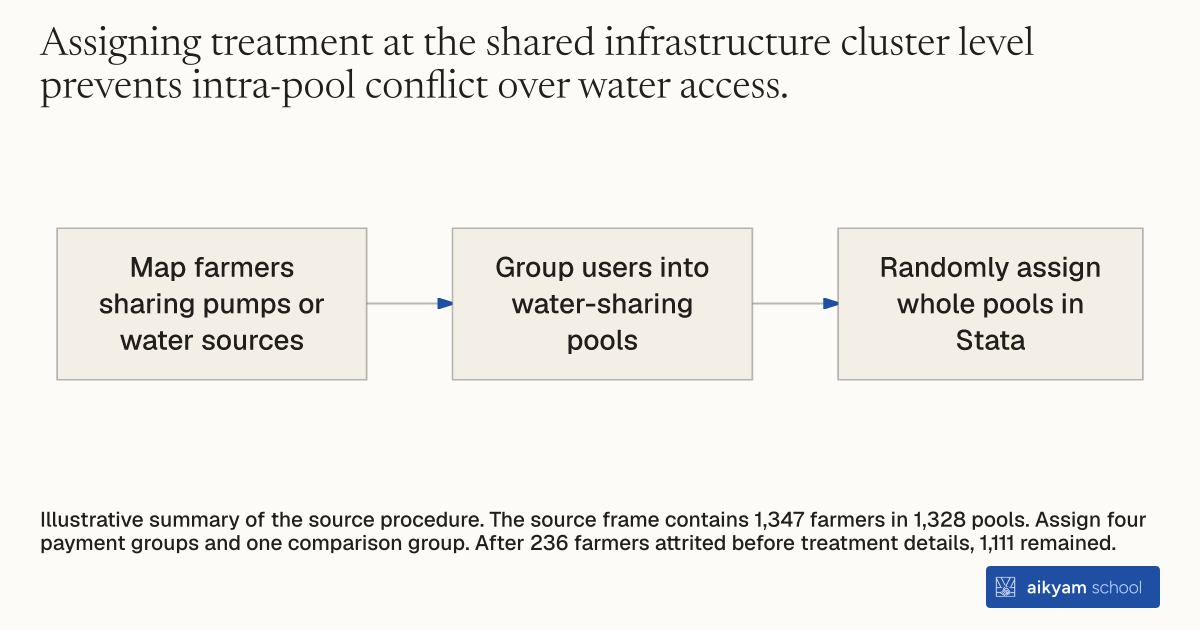
- Map farmers sharing pumps or water sources
- Group users into water-sharing pools
- Randomly assign whole pools in Stata
Illustrative summary of the source procedure. The source frame contains 1,347 farmers in 1,328 pools. Assign four payment groups and one comparison group. After 236 farmers attrited before treatment details, 1,111 remained.
See source →How
When to use
In agricultural communities, smallholder farmers often share tubewells, pumps, and water pipelines with neighboring farms. Randomizing experimental conservation programs at the individual farmer level causes social friction and creates spillovers among users of shared water sources. Program evaluators use cluster randomization at the water-sharing pool level to keep shared infrastructure units together under a single treatment condition.
Assign experimental treatments at the level of shared water infrastructure clusters rather than individual users.
- Map local agricultural tubewell networks to identify all smallholder farmers who share pumps or water sources.
- Group adjacent farmers into micro-clusters representing distinct water-sharing pools.
- Build a complete sampling frame of water-sharing pools across the target study region.
- Execute statistical cluster randomization in software to assign entire pools to intervention or comparison groups.
Why it works
It ensures that every farmer using the same shared pump operates under identical program rules and incentives.
Example
Researchers in Saurashtra, Gujarat, identified 1,347 smallholder farmers organized into 1,328 water-sharing pools of four or fewer farmers per pool. They ran cluster randomization in Stata to assign each pool to either one of four payment incentive groups or a comparison group. Although 236 farmers attrited before receiving treatment details, the cluster design successfully evaluated conservation responses across the remaining 1,111 farmers.
About the study
Participants
1,111 smallholder farmers (from a sampling frame of 1,347 farmers across 1,328 water-sharing pools, after 236 attrited) in Saurashtra, Gujarat, India.
Study Design
Cluster-randomized evaluation assigned at the water-sharing pool level in Stata across five treatment arms, with pumping monitored monthly using hours-of-use meters on pump starters from December 2022 to March 2023.
Results
Offering conservation payments at the pool cluster level decreased electricity consumption by 140 kilowatt-hours per month (23 percent) and reduced pumping duration by 10.4 hours per month relative to the comparison group average of 611 kilowatt-hours per month.