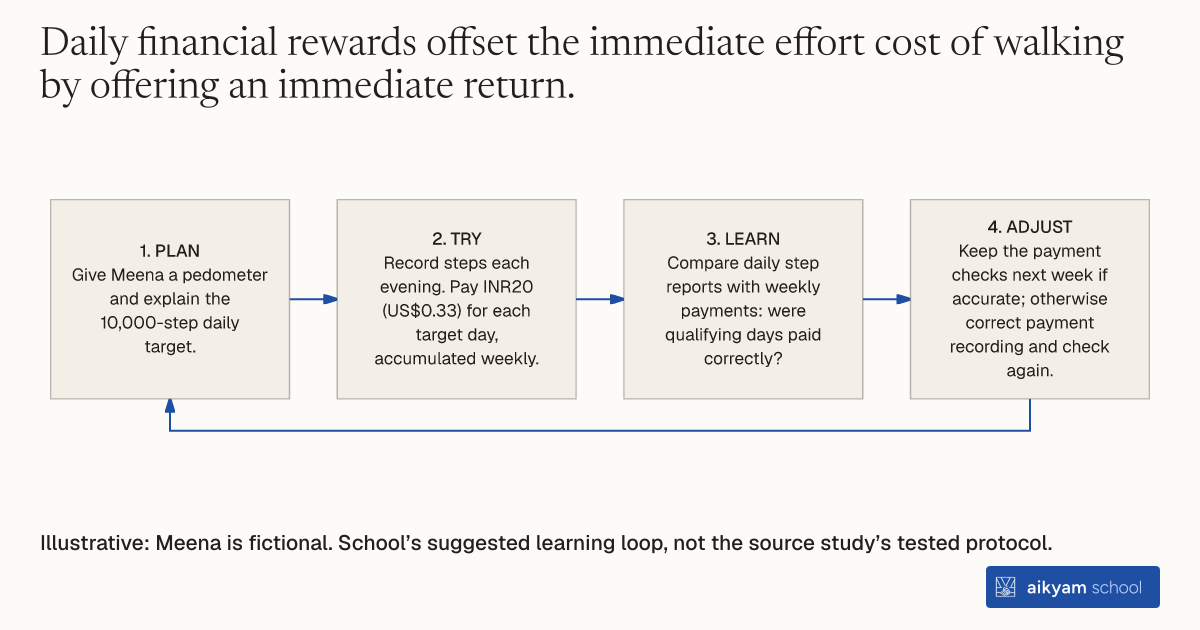
Try, learn and adjust
Check weekly walking rewards
- Plan: Give Meena a pedometer and explain the 10,000-step daily target.
- Try: Record steps each evening. Pay INR20 (US$0.33) for each target day, accumulated weekly.
- Learn: Compare daily step reports with weekly payments: were qualifying days paid correctly?
- Adjust: Keep the payment checks next week if accurate; otherwise correct payment recording and check again.
Illustrative: Meena is fictional. School’s suggested learning loop, not the source study’s tested protocol.
See source →School’s suggested, untested learning loop. Observe reported steps, qualifying days and weekly payments; no health effect is assumed.
How
When to use
Many adults with diabetes and prediabetes struggle to adopt daily exercise routines because physical effort carries immediate costs while health benefits appear later. Financial rewards provided for hitting step goals create an immediate benefit to encourage physical activity. Payers and health programs can offer weekly payments to motivate patients to achieve daily step targets.
Offer participants a weekly financial payment for each day they meet a daily step target.
- Issue pedometers to program participants to measure daily walking activity.
- Set a daily physical activity goal of 10,000 steps for each participant.
- Require participants to record and report their step counts every evening.
- Reward participants with INR20 (US$0.33) for every day they reach the 10,000-step target.
- Disburse the accumulated financial rewards to participants on a weekly schedule.
Why it works
Delivering payments on a weekly schedule maintains participant motivation while keeping administration simple and predictable.
Example
In Coimbatore, India, researchers provided diabetic and prediabetic participants with INR20 (US$0.33) for each day they reached 10,000 steps, distributing payments weekly over a twelve-week period.
About the study
Participants
3,192 adults in Coimbatore, India, averaging 49 years old, where 67 percent had doctor-diagnosed diabetes, 82 percent had elevated HbA1c, 49 percent had hypertension, and 61 percent had obesity.
Study Design
A randomized controlled trial evaluating physical activity incentives and step-monitoring contracts among recruited adults across eight intervention and comparison groups over twelve weeks.
Results
Offering INR20 per day increased 10,000-step target compliance by 20 percentage points (a 67 percent increase), increased walking by 1,266 steps per day, and improved the health risk index by 0.05 standard deviations relative to the comparison group.