Try, learn and adjust
Check days off and rotating police duties
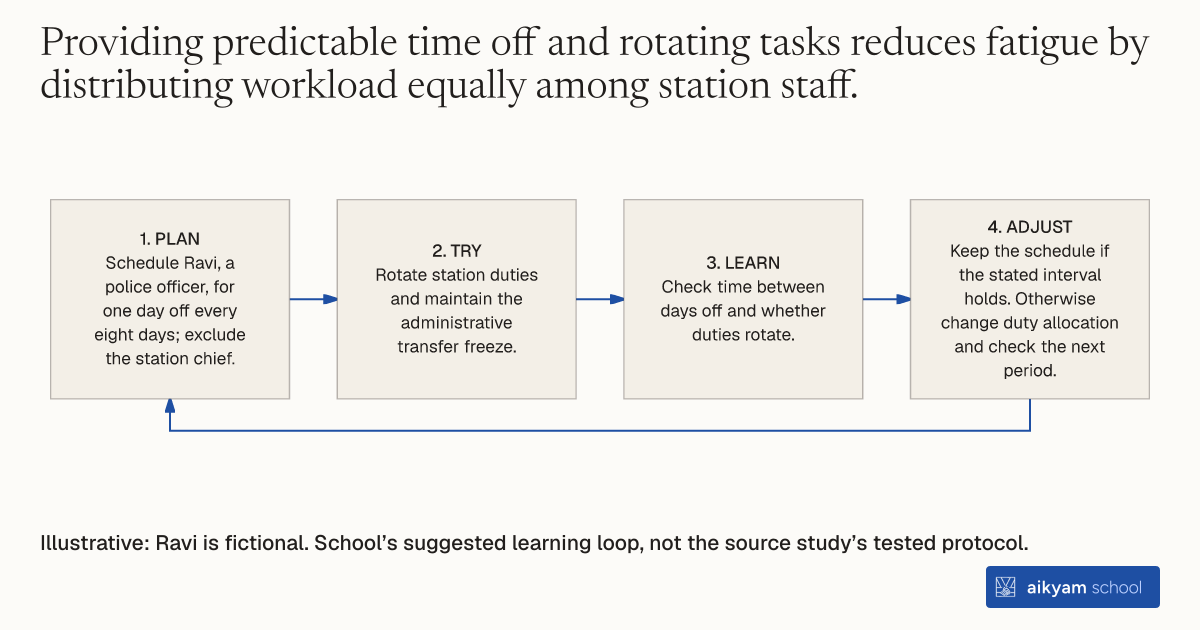
- Plan: Schedule Ravi, a police officer, for one day off every eight days; exclude the station chief.
- Try: Rotate station duties and maintain the administrative transfer freeze.
- Learn: Check time between days off and whether duties rotate.
- Adjust: Keep the schedule if the stated interval holds. Otherwise change duty allocation and check the next period.
Illustrative: Ravi is fictional. School’s suggested learning loop, not the source study’s tested protocol.
See source →School’s suggested learning loop, not the source’s tested procedure. Observe days off and task rotation. The source found intervals grew to 30 days and no major performance or community satisfaction changes.
How
When to use
Police officers face grueling working conditions without guaranteed time off and work twenty-four hours daily. Long hours and fixed tasks exhaust staff and lower morale across local police stations. Station leaders introduce a scheduled day off and task allocation system to improve working conditions.
Implement a weekly day off and rotating duty schedule for police station staff.
- Station supervisors exclude the station chief from the day off schedule.
- Station administrators grant each police officer one day off every eight days.
- Station supervisors assign officers to perform all station duties on a rotating basis.
- Department administrators freeze administrative transfers alongside the rotating schedule.
Example
The Rajasthan Police in India attempted to give officers one day off every eight days and rotate tasks equally across assigned stations. Eighty-four percent of treated stations offered days off, but the interval between days off grew to thirty days over time, yielding no major changes in performance or community satisfaction.
About the study
Participants
162 police stations in 11 districts across Rajasthan, India, serving 70,767 police personnel and 5,895 households.
Study Design
A randomized controlled trial evaluated police stations assigned to implement a weekly day off and duty rotation system against comparison stations using household surveys, staff interviews, and case file reviews.
Results
Eighty-four percent of treated stations implemented a rotating day off compared to 34 percent of comparison stations, but time between days off grew from 21 days to 30 days, resulting in no major changes in police performance or community satisfaction.