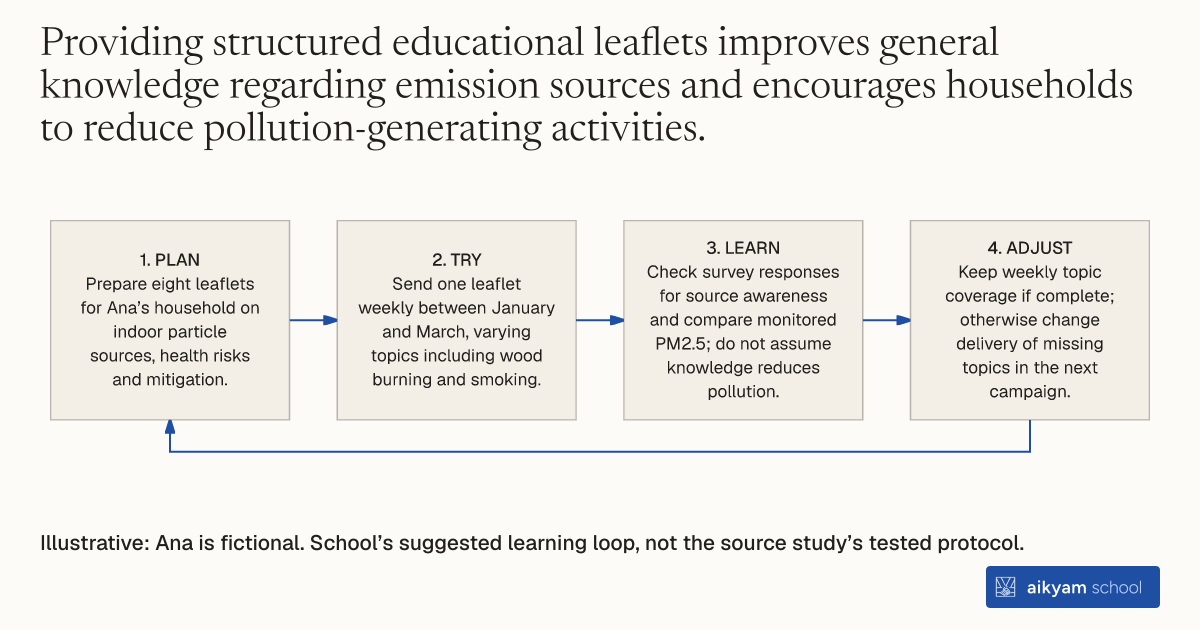
Try, learn and adjust
Check weekly pollution leaflets reach households
- Plan: Prepare eight leaflets for Ana’s household on indoor particle sources, health risks and mitigation.
- Try: Send one leaflet weekly between January and March, varying topics including wood burning and smoking.
- Learn: Check survey responses for source awareness and compare monitored PM2.5; do not assume knowledge reduces pollution.
- Adjust: Keep weekly topic coverage if complete; otherwise change delivery of missing topics in the next campaign.
Illustrative: Ana is fictional. School’s suggested learning loop, not the source study’s tested protocol.
See source →School’s suggested, untested learning loop. Observe awareness and monitored PM2.5. Generic leaflets produced no statistically significant PM2.5 reduction in the source.
How
When to use
Households spend significant time indoors yet often lack awareness of daily activities that generate fine particulate matter. Generic public health messaging attempts to educate communities on indoor pollution sources and potential mitigation techniques. This approach targets households using wood heating or engaging in other indoor combustion practices.
Distribute weekly educational leaflets on indoor air pollution sources and mitigation techniques to wood-burning households.
- Design a series of eight informational leaflets focusing on indoor particulate matter emissions and mitigation practices.
- Vary the specific leaflet topics each week while emphasizing emissions from residential wood burning and cigarette smoking.
- Include educational content covering daily indoor activities that generate particulate pollution and their associated health risks.
- Detail practical mitigation techniques households can adopt to reduce fine particulate matter generation.
- Deliver one leaflet weekly to target households over an eight-week campaign period between January and March.
Why it works
However, generic information alone does not alter personal health risk perceptions or reduce indoor pollution levels because residents do not recognize their own baseline risk.
Example
Researchers distributed eight weekly general information leaflets to 93 wood-heating households in France between January and March 2020. The campaign increased participant awareness of wood burning by 50 percent and cigarette smoking by 100 percent as primary pollution sources, but produced no significant reduction in indoor PM2.5 concentrations.
About the study
Participants
93 wood-heating households in France assigned to the general information group.
Study Design
Randomized controlled trial evaluating an eight-week leaflet campaign delivered from January to March 2020 against continuous indoor PM2.5 sensor monitoring and pre and post surveys.
Results
Identification of wood burning and cigarette smoking as primary indoor pollution sources increased by 50 percent and 100 percent respectively, but mean daily PM2.5 changed by -0.19 µg/m³ relative to the comparison group, which was not statistically significant.