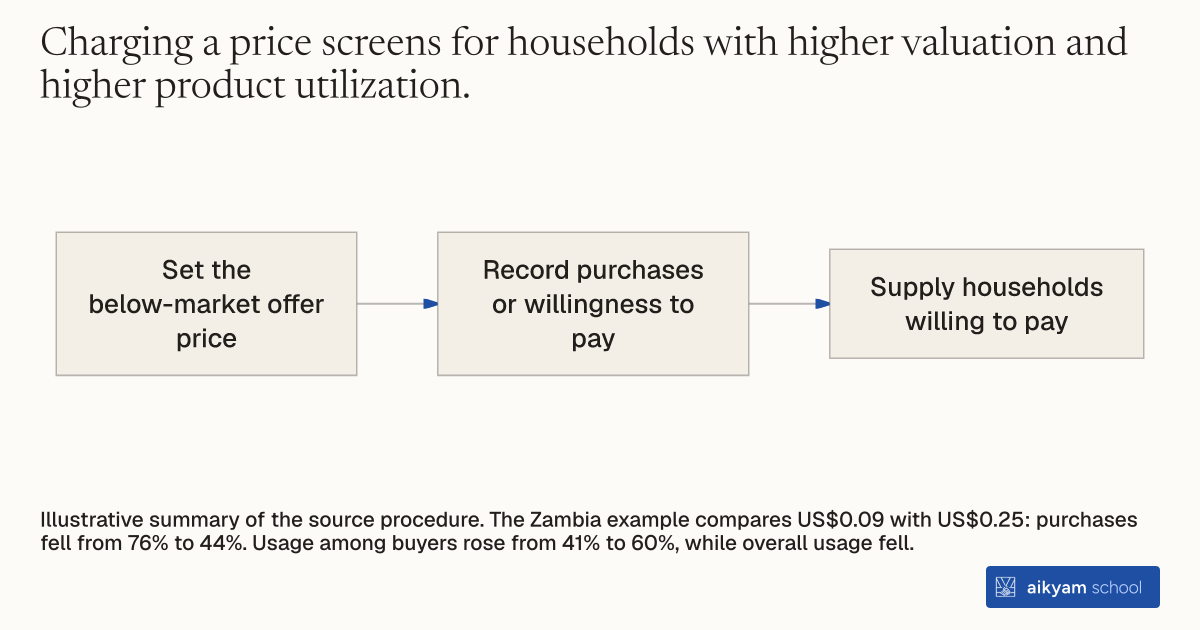
Research procedure
Observe demand at stated water treatment prices
- Set the below-market offer price
- Record purchases or willingness to pay
- Supply households willing to pay
Illustrative summary of the source procedure. The Zambia example compares US$0.09 with US$0.25: purchases fell from 76% to 44%. Usage among buyers rose from 41% to 60%, while overall usage fell.
See source →How
When to use
Many health programs consider charging small positive prices for point-of-use water treatment products to recover costs and screen out unmotivated households. Eliciting willingness-to-pay or setting positive prices tests household demand before offering products. Charging higher prices reduces overall coverage because price elasticity depresses purchases.
Elicit household willingness-to-pay or set small positive prices for point-of-use water treatment products to filter recipient interest.
- Determine a baseline or varying below-market price for a point-of-use water treatment product.
- Offer the water treatment product to targeted households at the specified price point.
- Record household purchasing decisions or willingness-to-pay valuations.
- Supply the water treatment product only to households willing to pay the required price.
Why it works
However, higher prices significantly reduce overall product adoption because price sensitivity deters many households from purchasing.
Example
In Zambia, offering a chlorine solution at prices increasing from US$0.09 to US$0.25 decreased one-time purchases from 76 percent to 44 percent, and although usage among buyers rose from 41 percent to 60 percent, overall chlorine usage decreased due to reduced demand.