Try, learn and adjust
Check every worker returns a benefit choice
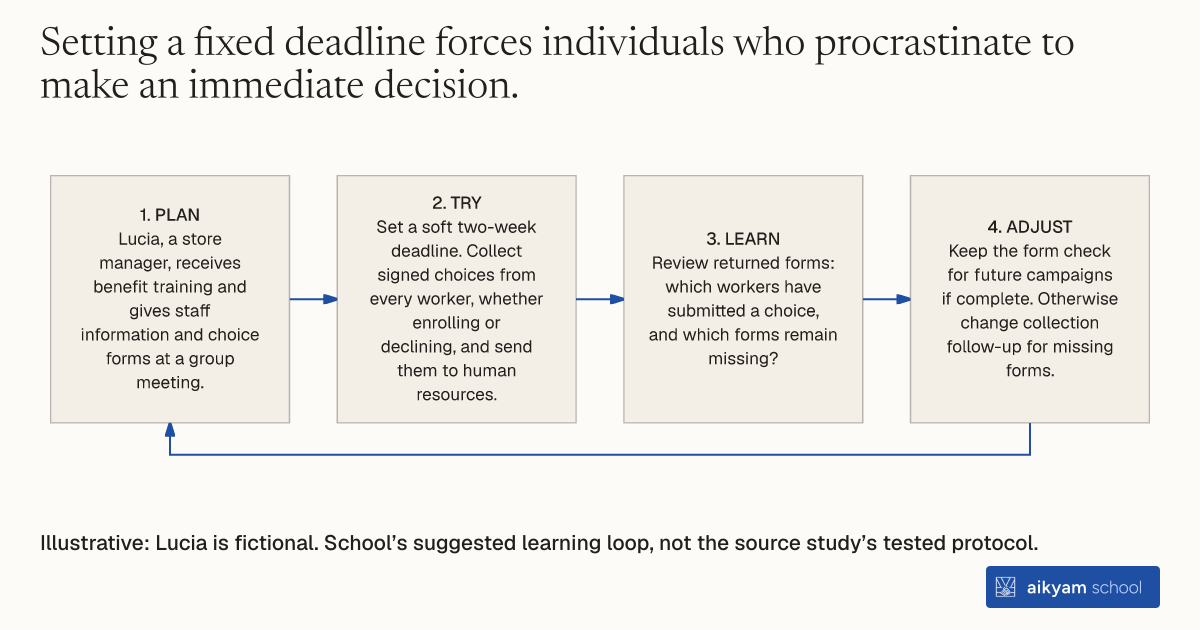
- Plan: Lucia, a store manager, receives benefit training and gives staff information and choice forms at a group meeting.
- Try: Set a soft two-week deadline. Collect signed choices from every worker, whether enrolling or declining, and send them to human resources.
- Learn: Review returned forms: which workers have submitted a choice, and which forms remain missing?
- Adjust: Keep the form check for future campaigns if complete. Otherwise change collection follow-up for missing forms.
Illustrative: Lucia is fictional. School’s suggested learning loop, not the source study’s tested protocol.
See source →School's suggested, untested loop: observe returned choices and processing; returning a form does not mean enrolling.
How
When to use
Low-income workers often avoid enrolling in eligible public benefits due to procrastination and social stigma. An active decision mechanism requires every employee to submit a benefit choice form by a specific deadline. Employers use this approach to increase program participation while reducing social stigma for eligible workers.
Mandate all employees to submit a signed form choosing whether to enroll in a workplace benefit program within a fixed timeframe.
- Store managers receive training on benefit rules and employee eligibility criteria.
- Managers distribute program information flyers and decision forms during routine group workplace meetings.
- Managers enforce a soft two-week deadline for all workers to return a choice form.
- Every employee submits a decision form regardless of whether they enroll or decline the benefit.
- Managers collect and process all decision forms through the human resources department.
Why it works
Requiring every worker to hand in paperwork reduces social stigma by making individual choices private.
Example
A nationwide retail firm implemented active decision enrollment across hourly employees in 12 store districts, raising Advance EITC participation from 0.3 percent to 1.2 percent and 401(k) participation from 46 percent to 50 percent.
About the study
Participants
The study observed 7,277 hourly employees across 185 stores in 19 districts, with a workforce that was 80 percent female, 30 percent Hispanic, 20 percent Black, and earning a median wage of $7.50 per hour.
Study Design
A randomized field experiment assigned retail store districts to an active decision treatment group or a control group and tracked employee payroll choices over 15 months.
Results
Active decision framing increased overall Advance EITC participation from 0.3 percent to 1.2 percent and boosted 401(k) participation by 4 to 4.5 percentage points.