In Simple Words
Imagine taking a high-stakes driving test while knowing that if you fail, you immediately win a free bicycle as a backup transport option. Because you are no longer terrified of walking home empty-handed, your nerves calm down and your hands stop shaking on the steering wheel. That reduction in stress helps you stay focused and pass the driving test with ease.
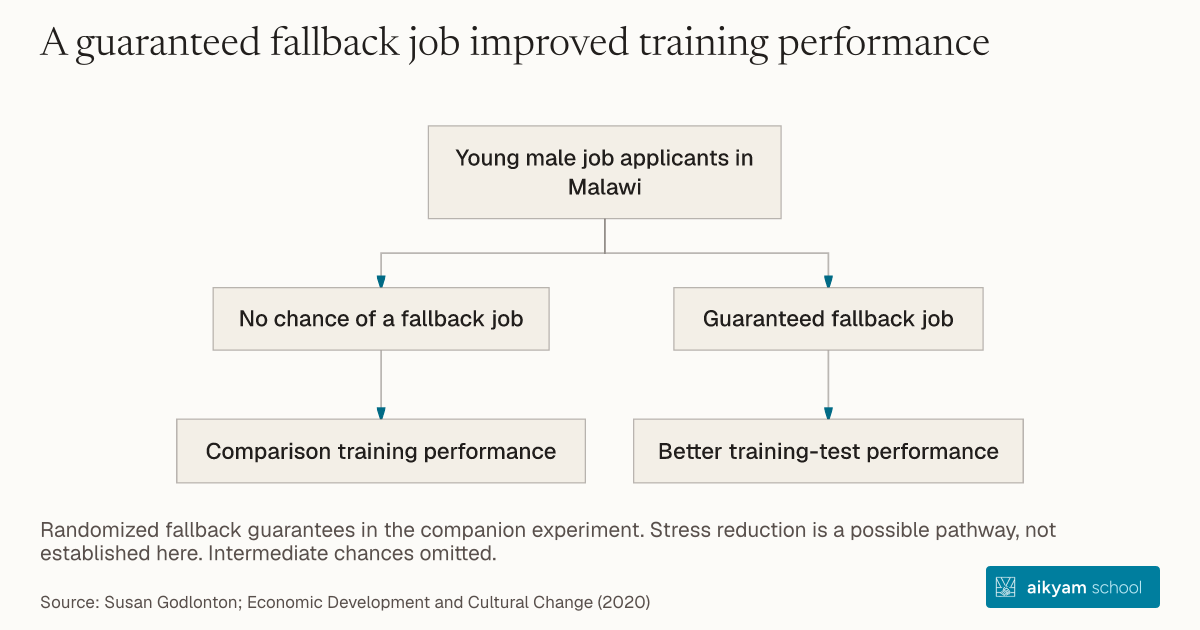
Young male job applicants in Malawi
- No chance of a fallback job
- Comparison training performance
- Guaranteed fallback job
- Better training-test performance
Randomized fallback guarantees in the companion experiment. Stress reduction is a possible pathway, not established here. Intermediate chances omitted.
See source →Research question
Job seekers undergoing competitive pre-employment evaluations face high stress due to employment uncertainty, which can impair test performance and recruitment outcomes. Providing guaranteed safety-net employment options mitigates anxiety, enabling applicants to perform significantly better during job selection tests.
Participants
N = 268 male youth job seekers (aged 18+, secondary school educated) in Lilongwe, Malawi.
Study Design
Stratified Randomized Controlled Trial (RCT) evaluating pre-employment test scores across probabilistic outside job guarantee options (0% to 100%).
Results
Standardized training test scores strongly predict competitive hiring, with a 1 standard deviation score increase yielding a 9.7 percentage point higher hiring likelihood (R² = 0.357). High probabilistic job guarantees caused candidates to perform significantly better on training assessment tests due to reduced job-uncertainty stress.
Takeaway
Implement guaranteed baseline employment safety nets during competitive hiring filters to eliminate anxiety-driven underperformance among candidates.
Source and citation
See source →Read alongside the research
Plain-English glossary
Original explanations, informed by the references below. Examples are illustrations, not data from the studies above. The research text stays unchanged.
- Percentage points
The difference between two percentages.
ExampleA rise from 40% to 50% is 10 percentage points. Relative to the starting value, that is a 25% increase.
Office for National Statistics · Percentages ↗Read more about percentage points →- Randomized controlled trial
A study that uses chance, like drawing lots, to decide who receives each option being compared. Researchers compare the groups’ outcomes to estimate the effect of those options.
ExampleA lottery assigns volunteers to a training programme or a comparison group. Researchers then compare their outcomes.
GET-IT glossary · Randomized study ↗Read more about randomized controlled trial →