In Simple Words
Receiving an official letter warning that you will undergo intense weekly compliance audits starting next month causes you to resolve your situation immediately, long before the auditor ever knocks on your door.
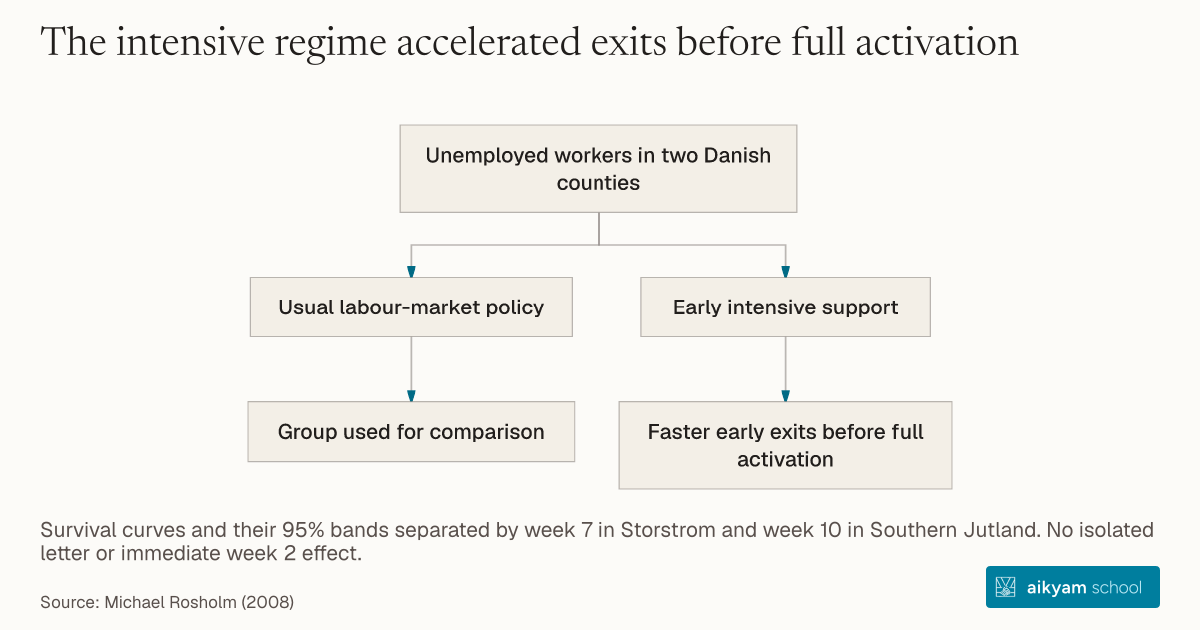
Unemployed workers in two Danish counties
- Usual labour-market policy
- Group used for comparison
- Early intensive support
- Faster early exits before full activation
Survival curves and their 95% bands separated by week 7 in Storstrom and week 10 in Southern Jutland. No isolated letter or immediate week 2 effect.
See source →Research question
Evaluating labor interventions exclusively upon physical program enrollment ignores immediate behavioral search shifts triggered when unemployed workers are first informed of upcoming mandatory obligations.
Participants
N = 4,513 unemployed UI recipients (human, Denmark: Storstrøm and Southern Jutland counties).
Study Design
RCT duration model measuring exit hazard rates starting on the exact date of written notification receipt.
Results
Exit rates from unemployment began diverging significantly between treatment and control groups almost immediately upon receipt of the notification letter in week 2, well before mandatory 18-week full-time programs commenced.
Takeaway
Issue official, early notification letters detailing future mandatory activation milestones upon initial unemployment registration to trigger immediate job search behavioral shifts.
Source and citation
See source →Read alongside the research
Plain-English glossary
Original explanations, informed by the references below. Examples are illustrations, not data from the studies above. The research text stays unchanged.
- Randomized controlled trial
A study that uses chance, like drawing lots, to decide who receives each option being compared. Researchers compare the groups’ outcomes to estimate the effect of those options.
ExampleA lottery assigns volunteers to a training programme or a comparison group. Researchers then compare their outcomes.
GET-IT glossary · Randomized study ↗Read more about randomized controlled trial →