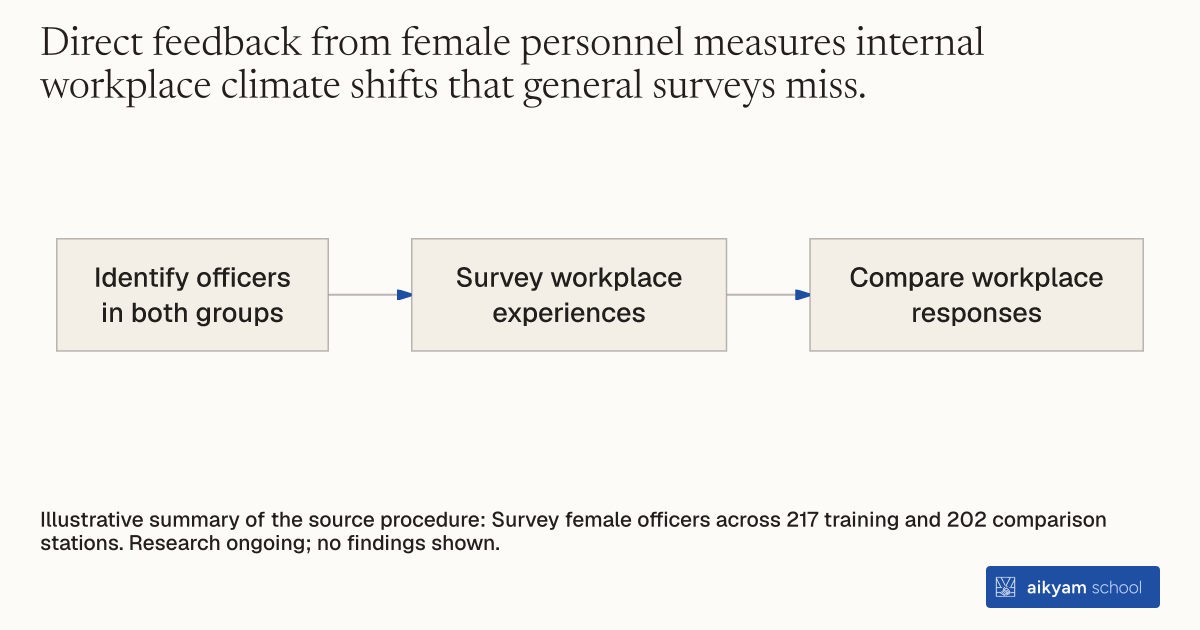
Research survey
Ask female officers about work
- Identify officers in both groups
- Survey workplace experiences
- Compare workplace responses
Illustrative summary of the source procedure: Survey female officers across 217 training and 202 comparison stations. Research ongoing; no findings shown.
See source →How
When to use
Female police officers face discriminatory workplace conditions and biases inside police stations. Evaluating organizational gender-sensitivity requires measuring changes in internal working environment for female staff. Conduct a specialized workplace survey among female police officers to measure intervention impacts on institutional working conditions.
Measure the impact of gender-sensitization training on internal working conditions by surveying female police officers across stations.
- Design a survey instrument focusing on workplace environment, discrimination, and daily station experiences of female officers.
- Identify female police personnel across treatment and comparison police stations.
- Deploy trained surveyors from an independent research firm to administer the survey.
- Collect responses regarding station working conditions, peer interactions, and professional support.
- Analyze workplace outcomes to evaluate institutional shifts resulting from gender-sensitivity training.
Why it works
Evaluating female officers' experiences reveals whether training reduces gender bias and improves station culture.
Example
Researchers deployed surveyors from DAI Research & Advisory Services to survey female police officers across 419 police stations in Bihar, India to assess workplace conditions.
About the study
Participants
Female police officers across 419 police stations in Bihar, India.
Study Design
Randomized controlled trial evaluating workplace survey responses across 217 treatment stations and 202 comparison stations.
Results
Research ongoing; results forthcoming.