Research allocation
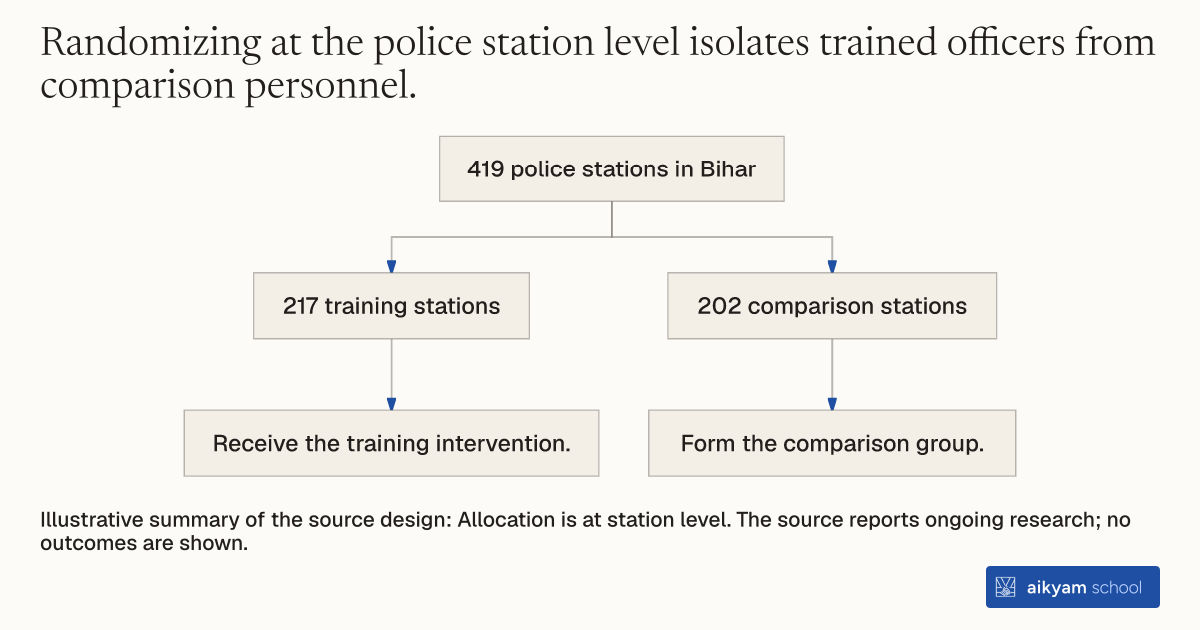
Randomly assign police stations
419 police stations in Bihar
- 217 training stations
- Receive the training intervention.
- 202 comparison stations
- Form the comparison group.
Illustrative summary of the source design: Allocation is at station level. The source reports ongoing research; no outcomes are shown.
See source →How
When to use
In law enforcement evaluations, individual officer randomization risks contamination when officers interact at the same station. Station-level cluster allocation prevents spillovers between trained and untrained personnel. Use randomized cluster allocation across police stations to rigorously evaluate institutional training programs.
Randomly assign police stations to intervention or comparison groups to evaluate training impacts without spillover.
- Map and compile a roster of participating police stations across the target region.
- Set cluster boundaries at the police station level to contain daily interactions within stations.
- Assign unique identification codes to all listed police stations.
- Generate a random allocation sequence using statistical software.
- Assign 217 police stations to the training intervention group and 202 stations to the comparison group.
Why it works
This cluster allocation prevents information spillovers and allows researchers to measure true organizational shifts.
Example
Researchers randomly assigned 217 police stations to the intervention group and 202 police stations to the comparison group in Bihar, India.
About the study
Participants
3,526 police officers in 419 police stations across Bihar, India.
Study Design
Cluster randomized controlled trial allocating 419 police stations into treatment and comparison groups.
Results
Research ongoing; results forthcoming.