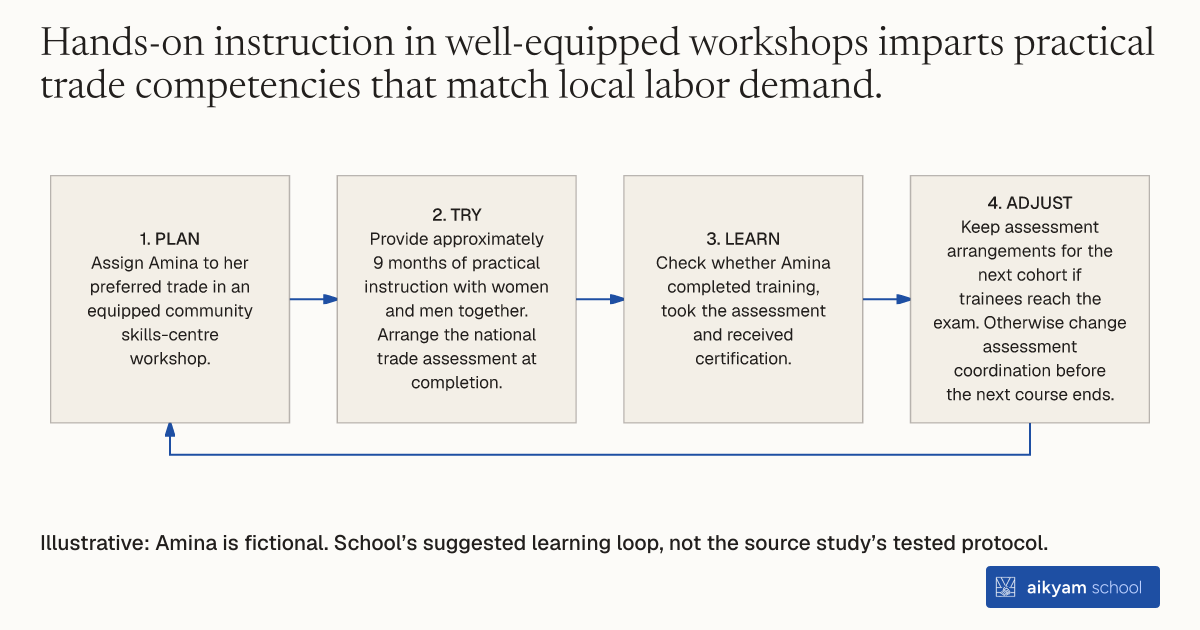
Try, learn and adjust
Check workshop training leads to formal assessment
- Plan: Assign Amina to her preferred trade in an equipped community skills-centre workshop.
- Try: Provide approximately 9 months of practical instruction with women and men together. Arrange the national trade assessment at completion.
- Learn: Check whether Amina completed training, took the assessment and received certification.
- Adjust: Keep assessment arrangements for the next cohort if trainees reach the exam. Otherwise change assessment coordination before the next course ends.
Illustrative: Amina is fictional. School’s suggested learning loop, not the source study’s tested protocol.
See source →School’s suggested learning loop: observe training completion, assessment and certification; certification alone does not establish employment gains.
How
When to use
Adolescents from low-income religious communities often lack market-relevant technical skills required for gainful employment. Standard academic schooling may fail to provide practical trade instruction or formal credentials. Delivering hands-on vocational training in dedicated workshops with certified assessment enables disadvantaged youth to acquire viable market skills.
Provide hands-on technical instruction in specialized trade workshops and assess participants for official certification.
- Establish fully equipped training workshops across community skills development centers.
- Select target trades relevant to local markets, including carpentry, electrical installation, fashion design, hospitality, masonry, office management, and welding.
- Assign participants to their preferred technical trade prior to training.
- Deliver trade-specific workshop instruction led by skilled instructors for approximately 9 months.
- Train male and female participants together in the same workshop classrooms.
- Administer national trade assessment examinations supervised by the National Board of Technical Education upon course completion.
Why it works
Formal trade certification provides a recognized credential that validates skills to prospective employers and customers.
Example
Under the Mafita project in Northern Nigeria, 900 impoverished youth received 9 months of workshop-based vocational training across six Community Skills Development Centers in Kaduna and Katsina states. Participants learned one of seven technical trades from skilled instructors. Upon completion, trainees took national assessment exams, resulting in 70 percent of participants earning official trade certification.
About the study
Participants
900 youth aged 15 to 24 randomized into training across six centers in Kaduna and Katsina states, Northern Nigeria.
Study Design
Randomized controlled trial comparing 900 assigned trainees to 924 control group participants, measuring outcomes approximately 12 months after training completion.
Results
Vocational training increased the income and employment index by 0.241 standard deviations, wage employment by 39 percent, monthly wage income by 54 percent, and business profits by 38.7 percent.