Try, learn and adjust
Check training is followed by an internship
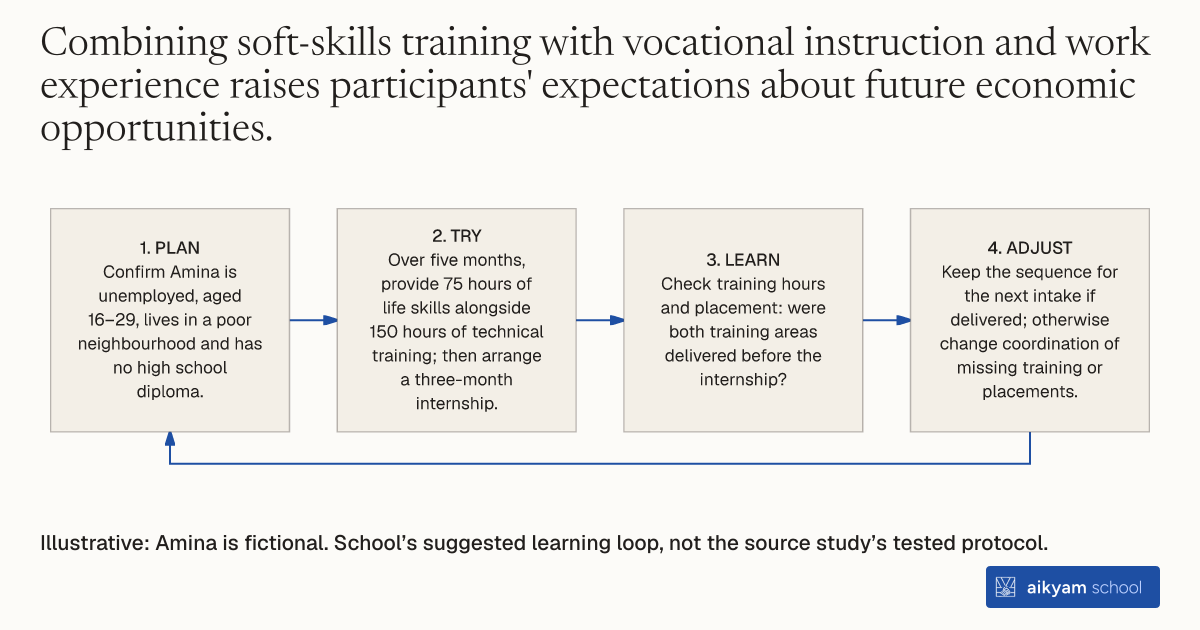
- Plan: Confirm Amina is unemployed, aged 16–29, lives in a poor neighbourhood and has no high school diploma.
- Try: Over five months, provide 75 hours of life skills alongside 150 hours of technical training; then arrange a three-month internship.
- Learn: Check training hours and placement: were both training areas delivered before the internship?
- Adjust: Keep the sequence for the next intake if delivered; otherwise change coordination of missing training or placements.
Illustrative: Amina is fictional. School’s suggested learning loop, not the source study’s tested protocol.
See source →School’s suggested, untested learning loop. Observe training hours and internship delivery. The training areas share the five-month period; no pregnancy outcome is assumed.
How
When to use
Unemployed adolescent females and young women in low-income neighborhoods often face high rates of unplanned pregnancy due to limited economic options. Providing structured vocational training and practical work experience helps build soft skills and raises future career expectations. This approach targets unemployed females aged 16 to 29 without a high school diploma.
Enroll unemployed young women in a comprehensive job training program combining classroom instruction and a practical internship.
- Program administrators recruit unemployed females aged 16 to 29 living in poor neighborhoods without a high school diploma.
- Trainers deliver 75 hours of basic life-skills and soft-skills training over five months.
- Instructors deliver 150 hours of technical and vocational skill training over the same five-month period.
- Program coordinators place participants in a three-month practical internship at a local business.
Why it works
These elevated career prospects encourage young women to engage in productive economic activities and avoid risky sexual behaviors.
Example
In the Dominican Republic from 2008 to 2011, the Juventud y Empleo program provided five months of training and a three-month internship to unemployed females aged 16 to 29, which reduced pregnancy among participants aged 16 to 19 by 7.8 percentage points (20 percent) 18 to 24 months after graduation.