In Simple Words
Imagine a quiet inventor who stumbles during spoken presentations but can showcase a fully functional digital portfolio online. Training the inventor to build a structured online profile lets prospective partners evaluate concrete achievements directly rather than relying on verbal pitch confidence.
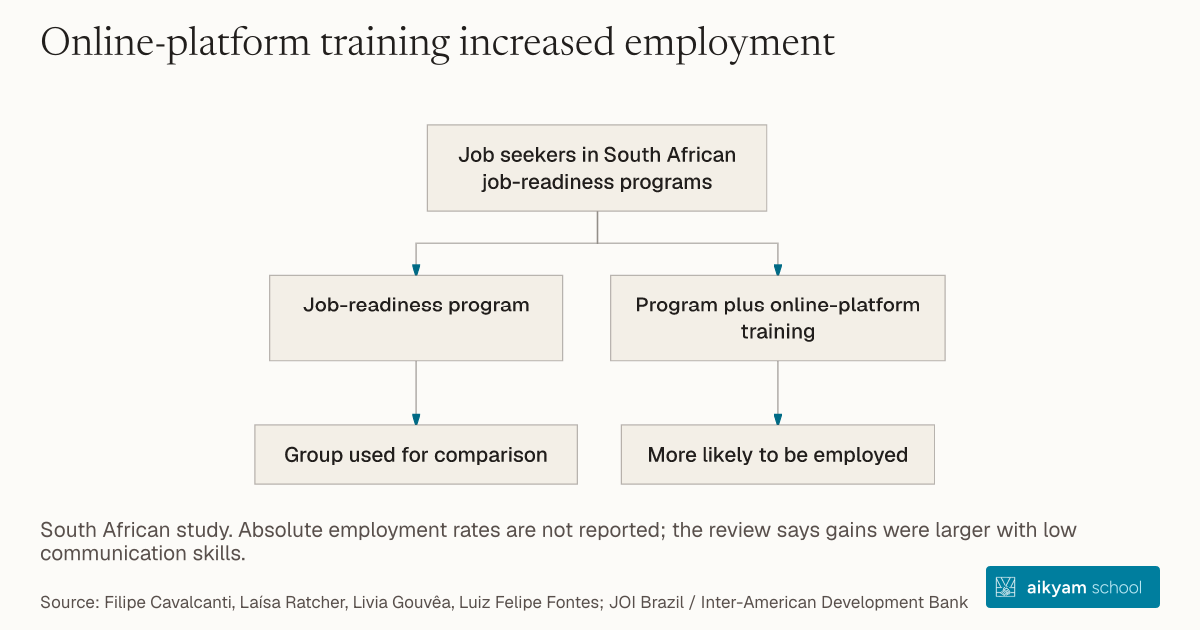
Job seekers in South African job-readiness programs
- Job-readiness program
- Group used for comparison
- Program plus online-platform training
- More likely to be employed
The source describes adding training about online employment platforms to labor market preparation programs and reports increased employment. The comparison is the underlying preparation program. The review also reports larger results for candidates with low communication skills, without providing an interaction estimate here.
See source →Research question
Job seekers with lower formal communication skills struggle to convey qualifications through traditional resumes and cover letters. This barrier restricts candidate visibility to potential employers and reduces job placement rates on modern digital labor platforms.
Participants
Job-seeking youth participating in labor market preparation programs in South Africa.
Study Design
Randomized Controlled Trial (RCT) evaluating LinkedIn platform navigation training added to traditional job readiness programs.
Results
Platform training significantly increased employment rates, with the largest gains observed among job seekers with low baseline communication skills who leveraged digital profiles to offset written or verbal presentation limitations.
Takeaway
Incorporate hands-on online labor profile creation modules into standard public employment job-readiness workshops.
Source and citation
See source →Evidence in Labor Market Policies and Implications for Brazil: Job Search Assistance
Copyright © 2023 Inter-American Development Bank.
Full source notice
Copyright © 2023 Inter-American Development Bank ("IDB"). This work is subject to a Creative Commons license CC BY 3.0 IGO (https://creativecommons.org/licenses/by/3.0/igo/legalcode). The terms and conditions indicated in the URL link must be met and the respective recognition must be granted to the IDB. Further to section 8 of the above license, any mediation relating to disputes arising under such license shall be conducted in accordance with the WIPO Mediation Rules. Any dispute related to the use of the works of the IDB that cannot be settled amicably shall be submitted to arbitration pursuant to the United Nations Commission on International Trade Law (UNCITRAL) rules. The use of the IDB's name for any purpose other than for attribution, and the use of IDB's logo shall be subject to a separate written license agreement between the IDB and the user and is not authorized as part of this license. Note that the URL link includes terms and conditions that are an integral part of this license.
Read alongside the research
Plain-English glossary
Original explanations, informed by the references below. Examples are illustrations, not data from the studies above. The research text stays unchanged.
- Baseline
The starting measurements in a study. Researchers use these to compare what participants were like at the start with what happens later.
ExampleBefore a training programme starts, researchers measure workers’ earnings. That first measurement is the baseline.
GET-IT glossary · Baseline characteristics ↗Read more about baseline →- Randomized controlled trial
A study that uses chance, like drawing lots, to decide who receives each option being compared. Researchers compare the groups’ outcomes to estimate the effect of those options.
ExampleA lottery assigns volunteers to a training programme or a comparison group. Researchers then compare their outcomes.
GET-IT glossary · Randomized study ↗Read more about randomized controlled trial →