In Simple Words
Imagine offering a flat $50 reward versus a flat $100 reward to anyone who brings a guest to a party. A higher cash reward gets more people to bring guests through the door, but because the payout is guaranteed regardless of how well the guest behaves, hosts bring whoever is closest rather than searching for the most polite or entertaining guest.
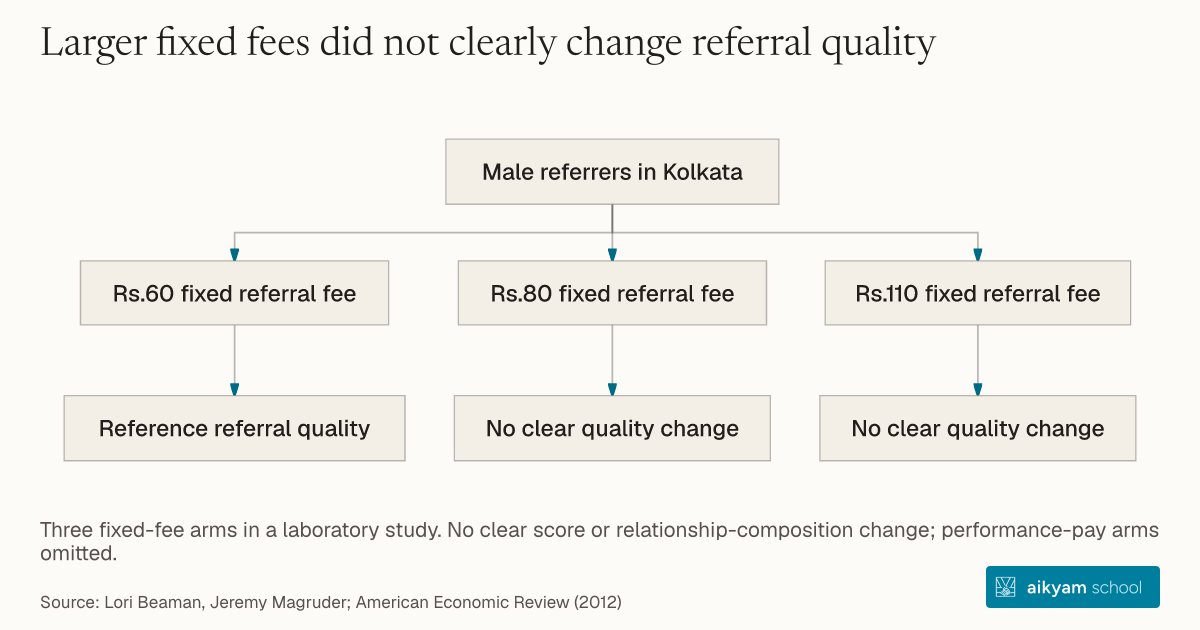
Male referrers in Kolkata
- Rs.60 fixed referral fee
- Reference referral quality
- Rs.80 fixed referral fee
- No clear quality change
- Rs.110 fixed referral fee
- No clear quality change
Three fixed-fee arms in a laboratory study. No clear score or relationship-composition change; performance-pay arms omitted.
See source →Research question
Increasing flat financial payments for employee referrals expands the total volume of job applicants but fails to improve candidate quality or skill composition.
Participants
N = 310 male original labor market participants in Kolkata, India.
Study Design
Heckman two-step selection model utilizing daily rainfall variations as an exclusion restriction to test varying flat finder's fees (Rs 60, Rs 80, Rs 110).
Results
Increasing fixed finder's fees from Rs 60 to Rs 110 increased referral participation by 8 percentage points (p < 0.10) but had zero statistically significant impact on referral cognitive test scores (p = 0.865) or referral relationship composition.
Takeaway
Do not increase flat monetary referral bonuses under the expectation of hiring higher-quality talent, as fixed fees alter applicant quantity without altering applicant quality.
Source and citation
See source →Read alongside the research
Plain-English glossary
Original explanations, informed by the references below. Examples are illustrations, not data from the studies above. The research text stays unchanged.
- Percentage points
The difference between two percentages.
ExampleA rise from 40% to 50% is 10 percentage points. Relative to the starting value, that is a 25% increase.
Office for National Statistics · Percentages ↗Read more about percentage points →- Statistically significant
A label used when a result passes a chosen statistical threshold, often p < 0.05. It does not show how large or useful an effect is. A result that is not statistically significant does not prove there is no effect.
ExampleA study reports p = 0.03 against a 0.05 threshold. It passes that test, but the effect could still be too small to matter.
American Statistical Association · Statement on p-values ↗Read more about statistically significant →