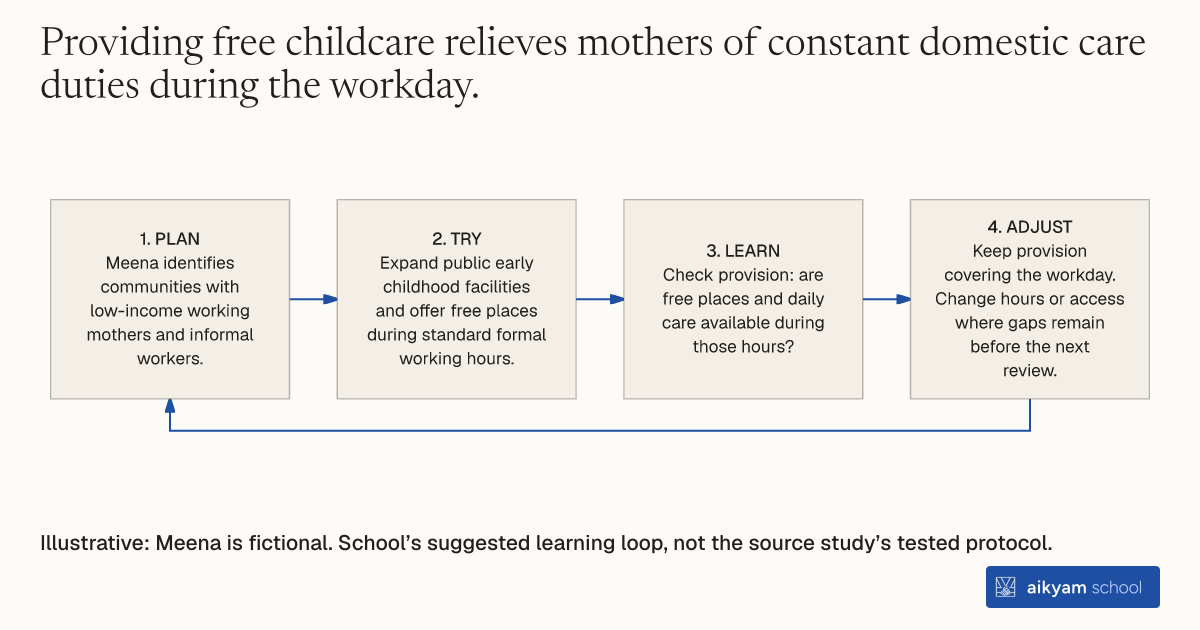
Try, learn and adjust
Check free childcare covers working hours
- Plan: Meena identifies communities with low-income working mothers and informal workers.
- Try: Expand public early childhood facilities and offer free places during standard formal working hours.
- Learn: Check provision: are free places and daily care available during those hours?
- Adjust: Keep provision covering the workday. Change hours or access where gaps remain before the next review.
Illustrative: Meena is fictional. School’s suggested learning loop, not the source study’s tested protocol.
See source →Observe free places and care hours; do not assume changes in mothers’ employment from this check alone. School suggests this learning loop; it is not the source’s tested procedure.
How
When to use
Working mothers face a substantial increase in labor informality following childbirth due to disproportionate domestic care responsibilities. This situation forces female workers into flexible but precarious informal employment without social protection. It applies to municipal authorities seeking to reduce female informality and narrow gender employment gaps.
Construct and subsidize municipal early childhood education centers to provide free childcare for working mothers.
- Identify urban areas with high concentrations of low-income working mothers and informal workers.
- Build or expand public early childhood education facilities within targeted local communities.
- Establish free enrollment slots for infants and young children of working mothers.
- Deliver daily early childhood education and care during standard formal working hours.
Why it works
This support allows women to maintain continuous formal employment without sacrificing job security or earnings.
Example
In Brazil, municipal provision of free early childhood education helped reduce the sharp increase in labor informality experienced by mothers after childbirth.
Source
See source →Evidence in Labor Market Policies and Implications for Brazil: Informality
Copyright © 2025 Inter-American Development Bank.
Full source notice
Copyright © 2025 Inter-American Development Bank ("IDB"). This work is subject to a Creative Commons license CC BY 3.0 IGO (https://creativecommons.org/licenses/by/3.0/igo/legalcode). The terms and conditions indicated in the URL link must be met and the respective recognition must be granted to the IDB. Further to section 8 of the above license, any mediation relating to disputes arising under such license shall be conducted in accordance with the WIPO Mediation Rules. Any dispute related to the use of the works of the IDB that cannot be settled amicably shall be submitted to arbitration pursuant to the United Nations Commission on International Trade Law (UNCITRAL) rules. The use of the IDB's name for any purpose other than for attribution, and the use of IDB's logo shall be subject to a separate written license agreement between the IDB and the user and is not authorized as part of this license. Note that the URL link includes terms and conditions that are an integral part of this license.