In Simple Words
Imagine trying to train for a marathon without a workout schedule; it is easy to skip daily runs when you feel discouraged. A goal-setting nudge provides a paper calendar and text message check-ins that act like a personal running coach. The coach asks you to write down how many miles you will run each week, sends reminders at the start of the week, and asks for a confirmation text at the end, turning vague intentions into actionable, tracked routines.
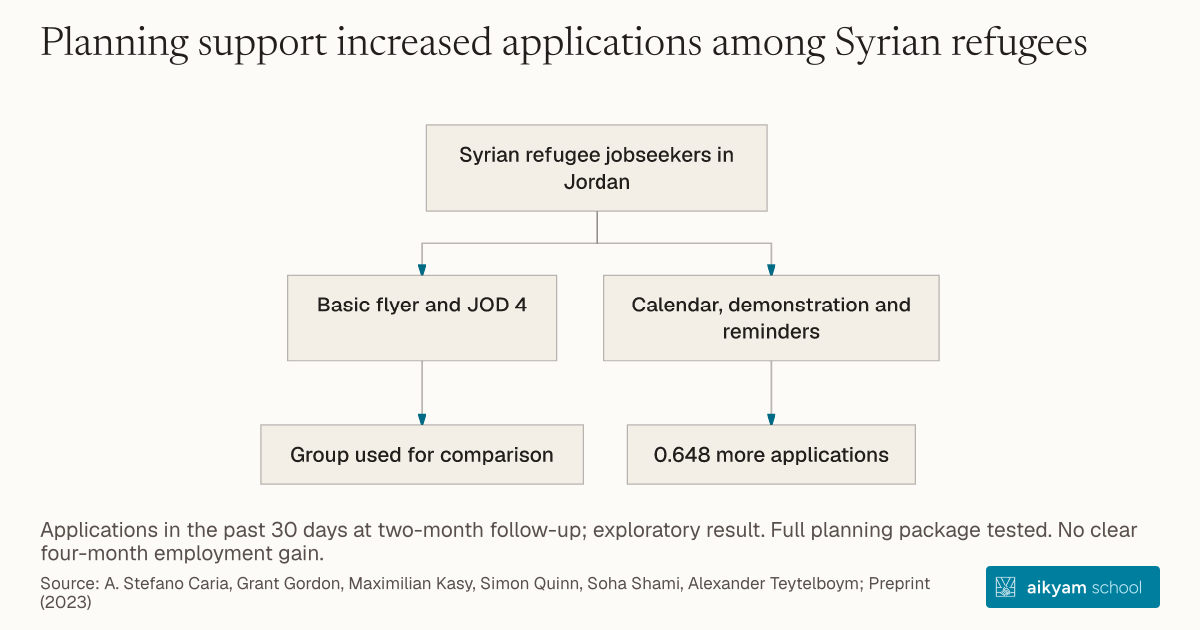
Syrian refugee jobseekers in Jordan
- Basic flyer and JOD 4
- Group used for comparison
- Calendar, demonstration and reminders
- 0.648 more applications
Applications in the past 30 days at two-month follow-up; exploratory result. Full planning package tested. No clear four-month employment gain.
See source →Research question
Jobseekers affected by displacement trauma, long-term unemployment, or self-control frictions often struggle to maintain structured job search schedules and meet baseline application goals. Without systematic goal-tracking mechanisms, psychological distress and procrastination suppress search effort over time.
Participants
N = 3,770 jobseekers (1,663 Syrian refugees and 2,107 Jordanians) in urban Jordan.
Study Design
Randomized controlled trial evaluating a packaged intervention comprising a 4-week planning calendar, instructional video, face-to-face demonstration, and twice-weekly automated SMS goal reminders.
Results
At two months, the nudge increased Syrian job applications by 55% (0.648 additional applications, p = 0.016) and Jordanian job search participation by 6.5 percentage points (p = 0.030). However, impacts on actual wage employment faded by four months (+0.003 for Syrians, p = 0.449; -0.002 for Jordanians, p = 0.544).
Takeaway
Deploy structured weekly planning calendars paired with automated goal-setting and goal-review text messages to jobseekers to mitigate self-control bottlenecks during active search phases.
Source and citation
See source →Read alongside the research
Plain-English glossary
Original explanations, informed by the references below. Examples are illustrations, not data from the studies above. The research text stays unchanged.
- Percentage points
The difference between two percentages.
ExampleA rise from 40% to 50% is 10 percentage points. Relative to the starting value, that is a 25% increase.
Office for National Statistics · Percentages ↗Read more about percentage points →- Randomized controlled trial
A study that uses chance, like drawing lots, to decide who receives each option being compared. Researchers compare the groups’ outcomes to estimate the effect of those options.
ExampleA lottery assigns volunteers to a training programme or a comparison group. Researchers then compare their outcomes.
GET-IT glossary · Randomized study ↗Read more about randomized controlled trial →