In Simple Words
Think of an integration agreement like a mandatory study schedule given to students. High-performing students who would study effectively on their own derive no benefit and may feel needlessly restricted, whereas struggling students who lack momentum get the structure and external push needed to achieve results.
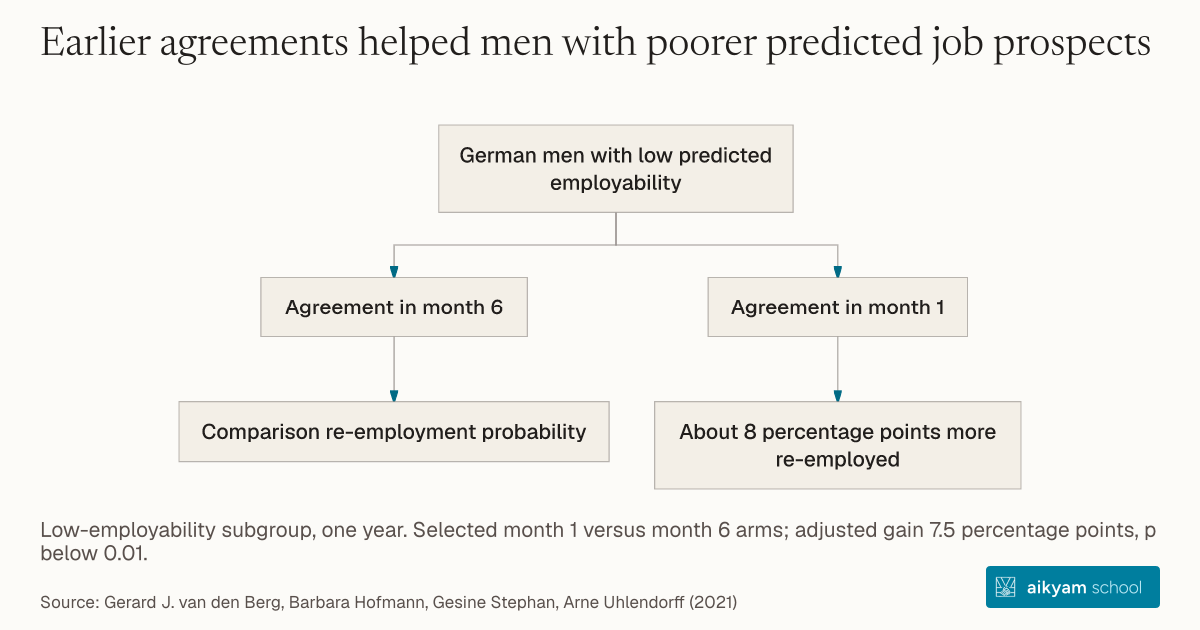
German men with low predicted employability
- Agreement in month 6
- Comparison re-employment probability
- Agreement in month 1
- About 8 percentage points more re-employed
Low predicted employability means median unemployment duration above six months. Within one year, month-one versus month-six assignment raised re-employment by 7.5 percentage points in the adjusted model; p below 0.01.
See source →Research question
Mandatory job integration agreements are frequently applied universally to all unemployed individuals, which risks imposing counterproductive administrative constraints on job seekers who already have strong labor market prospects.
Participants
N = 4,163 male unemployment insurance benefit recipients aged 25–64 in Germany (1,688 high employability; 2,475 low employability).
Study Design
Individual-level randomized controlled trial across five regional labor market agencies, stratifying individuals by predicted median unemployment duration calculated from a pre-experimental 2011 inflow sample of 55,545 individuals.
Results
For job seekers with low employability (predicted median duration exceeding 6 months), assignment to an early integration agreement (month 1 or 3) increased the 1-year re-employment probability from 45% (month 6 reference group D) to 53% (group A) and 54% (group C) (p < 0.01), representing an 8 percentage point or 18% relative increase; for high-employability job seekers, early integration agreements had no statistically significant effect (82% vs 82–83%).
Takeaway
Profile newly registered job seekers using predictive labor market duration models and restrict mandatory integration agreements to individuals classified as having low employability while granting immediate job search autonomy to those with high prospects.
Source and citation
See source →Read alongside the research
Plain-English glossary
Original explanations, informed by the references below. Examples are illustrations, not data from the studies above. The research text stays unchanged.
- Median
The middle number after arranging the values from smallest to largest. If there are two middle numbers, use their average.
ExampleFor the values 2, 4 and 12, the middle value is 4. The median is 4.
NIST · Measures of location ↗Read more about median →- Percentage points
The difference between two percentages.
ExampleA rise from 40% to 50% is 10 percentage points. Relative to the starting value, that is a 25% increase.
Office for National Statistics · Percentages ↗Read more about percentage points →- Randomized controlled trial
A study that uses chance, like drawing lots, to decide who receives each option being compared. Researchers compare the groups’ outcomes to estimate the effect of those options.
ExampleA lottery assigns volunteers to a training programme or a comparison group. Researchers then compare their outcomes.
GET-IT glossary · Randomized study ↗Read more about randomized controlled trial →- Statistically significant
A label used when a result passes a chosen statistical threshold, often p < 0.05. It does not show how large or useful an effect is. A result that is not statistically significant does not prove there is no effect.
ExampleA study reports p = 0.03 against a 0.05 threshold. It passes that test, but the effect could still be too small to matter.
American Statistical Association · Statement on p-values ↗Read more about statistically significant →