In Simple Words
Project QUEST acts as an academic wrap-around shield and financial buffer. Rather than operating its own classrooms, the program partners with public community colleges, covering students' tuition, books, exam fees, and living expenses while requiring weekly counseling and life-skills sessions. Simultaneously, program staff maintain relationships with local health systems to refer graduates directly into open jobs.
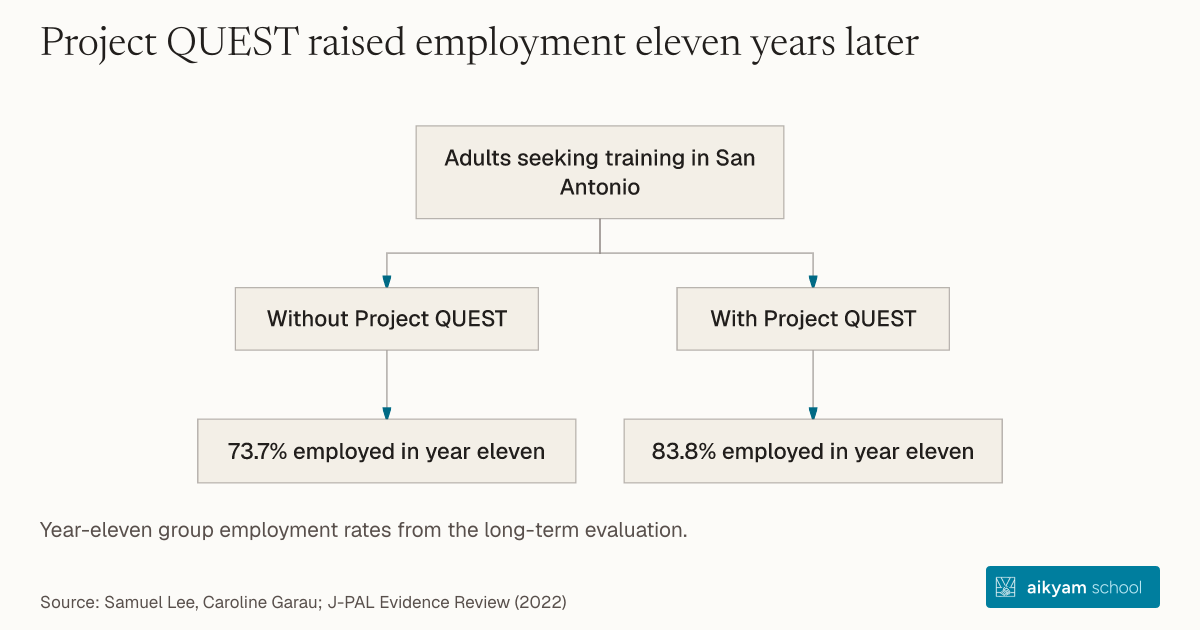
Adults seeking training in San Antonio
- Without Project QUEST
- 73.7% employed in year eleven
- With Project QUEST
- 83.8% employed in year eleven
The long-term Project QUEST evaluation reports year-eleven employment of 83.8% in the program group and 73.7% in the control group, a reported 10.1 percentage point difference. This is a between-group result eleven years into the evaluation, not an individual before-and-after change.
See source →Research question
Low-income individuals enrolling in community college vocational programs face high attrition rates due to financial strain, academic hurdles, and personal life crises. Without structured support systems, many students fail to complete high-value technical credentials in healthcare.
Participants
Low-income human adults in San Antonio, Texas, holding a high school diploma or GED and having at least 20 years of career horizon remaining.
Study Design
Longitudinal Randomized Controlled Trial (RCT) evaluated by Roder and Elliott (2018, 2021) measuring earnings and employment persistence across 6-year and 11-year post-enrollment windows.
Results
Annual earnings for participants were $5,080 higher (a 22% increase, p < 0.01) in Year 6 and remained $4,616 higher (a 15% increase, p < 0.01) in Year 11. In Year 11, participant employment reached 83.8% compared to 73.7% in the control group (a 10.1 percentage point increase, p < 0.01), representing the longest-sustained earnings gains in US workforce evaluation history.
Takeaway
Partner community college vocational degree tracks with comprehensive tuition support, mandatory weekly life-skills counseling, and direct health sector hiring channels.
Source and citation
See source →Read alongside the research
Plain-English glossary
Original explanations, informed by the references below. Examples are illustrations, not data from the studies above. The research text stays unchanged.
- Longitudinal study
A study that checks the same group of people at different times. This lets researchers examine how things change over time.
ExampleResearchers ask the same workers about their wellbeing at the start, after three months and after six months.
NICE · Longitudinal study ↗Read more about longitudinal study →- Percentage points
The difference between two percentages.
ExampleA rise from 40% to 50% is 10 percentage points. Relative to the starting value, that is a 25% increase.
Office for National Statistics · Percentages ↗Read more about percentage points →- Randomized controlled trial
A study that uses chance, like drawing lots, to decide who receives each option being compared. Researchers compare the groups’ outcomes to estimate the effect of those options.
ExampleA lottery assigns volunteers to a training programme or a comparison group. Researchers then compare their outcomes.
GET-IT glossary · Randomized study ↗Read more about randomized controlled trial →