Try, learn and adjust
Check support for vocational coursework
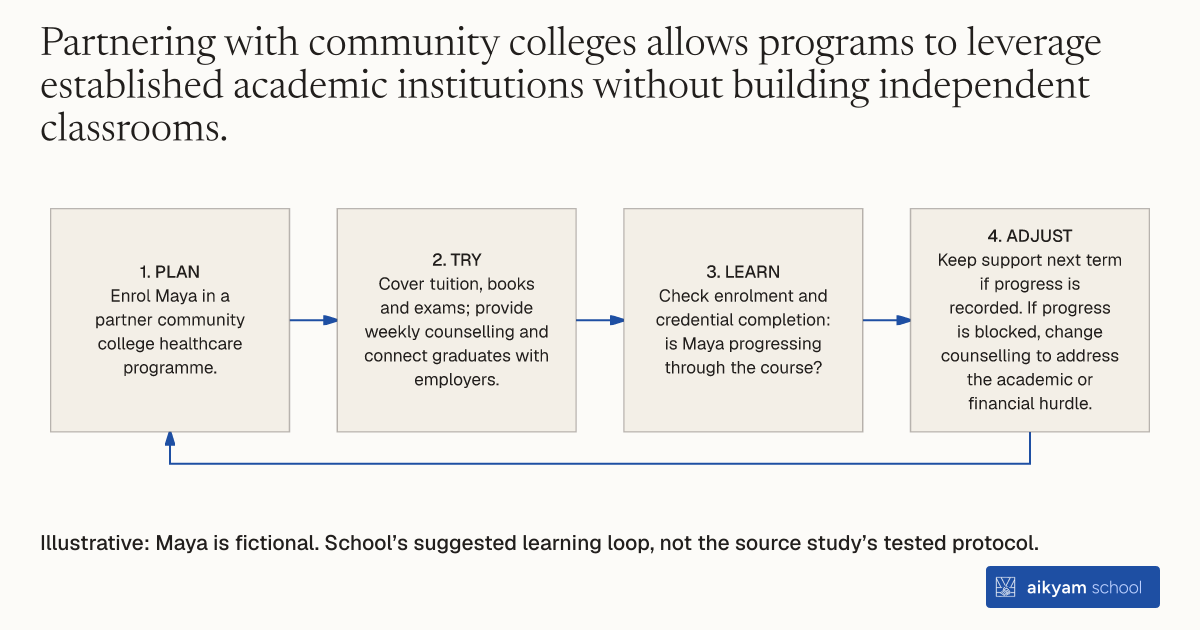
- Plan: Enrol Maya in a partner community college healthcare programme.
- Try: Cover tuition, books and exams; provide weekly counselling and connect graduates with employers.
- Learn: Check enrolment and credential completion: is Maya progressing through the course?
- Adjust: Keep support next term if progress is recorded. If progress is blocked, change counselling to address the academic or financial hurdle.
Illustrative: Maya is fictional. School’s suggested learning loop, not the source study’s tested protocol.
See source →School’s suggested, untested learning loop. Observe continued enrolment and credential completion; programme earnings gains do not isolate this partnership component.
How
When to use
Low-income individuals enrolling in community college vocational programs often face high dropout rates due to financial strain and academic hurdles. Unassisted college enrollment leaves many students unable to complete high-value technical credentials in growing sectors like healthcare. Program managers solve this problem by partnering directly with local community colleges to deliver wrapped occupational degree tracks.
Partner with local public community colleges to deliver structured sector-focused vocational education.
- Form official partnerships with local community college systems to utilize existing vocational course infrastructure.
- Select high-demand occupational degree or certificate programs in growing sectors such as health care.
- Enroll participants into community college coursework while providing full coverage for tuition, textbooks, and exam fees.
- Supplement college instruction with mandatory weekly counseling sessions focused on study habits and life skills.
- Connect community college graduates directly to partner employers in regional health systems.
Why it works
Providing comprehensive financial and counseling support enables students to stay enrolled and complete demanding multi-year vocational credentials.
Example
Project QUEST in San Antonio partnered with local community colleges to enroll participants in healthcare certification programs while covering college expenses.
About the study
Participants
Low-income adult job seekers holding a high school diploma or GED in San Antonio, Texas.
Study Design
Longitudinal Randomized Controlled Trial (RCT) evaluated by Roder and Elliott (2018, 2021) measuring earnings and employment across 6-year and 11-year post-enrollment windows.
Results
Community college partnership participants earned $5,080 more (a 22 percent increase, p < 0.01) in Year 6 and maintained $4,616 higher earnings (a 15 percent increase, p < 0.01) in Year 11, raising Year 11 employment to 83.8 percent compared to 73.7 percent in the control group.