Try, learn and adjust
Check training support meets financial needs
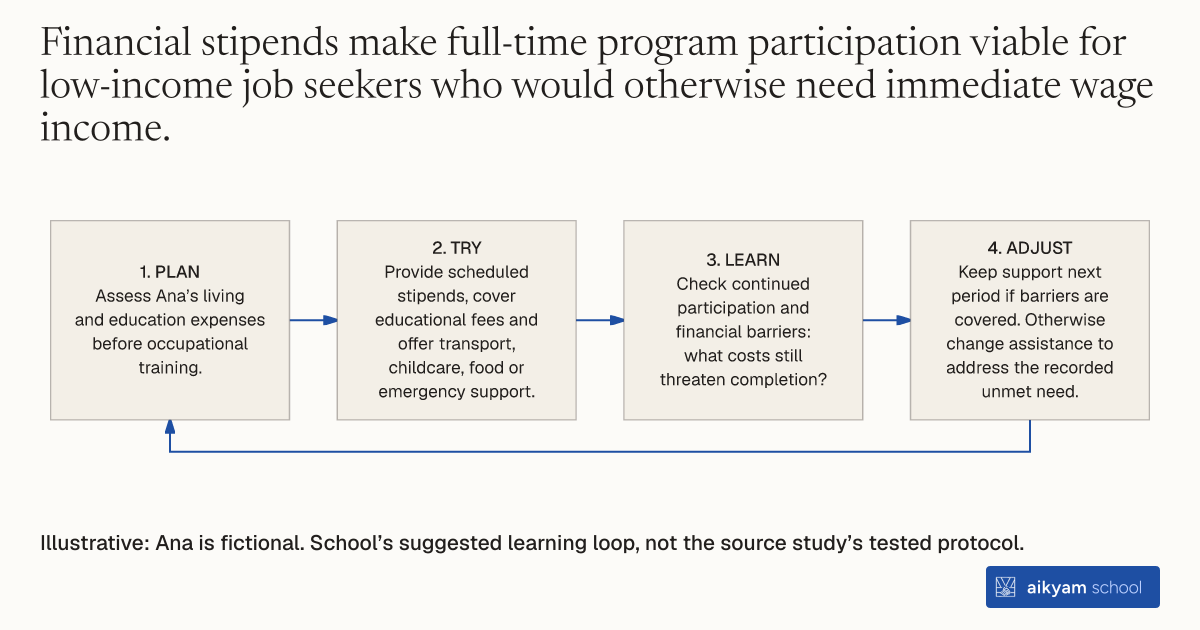
- Plan: Assess Ana’s living and education expenses before occupational training.
- Try: Provide scheduled stipends, cover educational fees and offer transport, childcare, food or emergency support.
- Learn: Check continued participation and financial barriers: what costs still threaten completion?
- Adjust: Keep support next period if barriers are covered. Otherwise change assistance to address the recorded unmet need.
Illustrative: Ana is fictional. School’s suggested learning loop, not the source study’s tested protocol.
See source →School’s suggested, untested learning loop. Observe financial barriers, participation and training completion; this loop does not establish earnings effects.
How
When to use
Low-income job seekers often cannot afford to participate in intensive full-time occupational training without income. Daily expenses for food, transportation, childcare, and supplies create financial strain that forces trainees to drop out before completing their credentials. Program directors solve this problem by providing direct financial stipends and material assistance to trainees during enrollment.
Distribute direct financial stipends and emergency financial assistance to cover living expenses and educational costs during training.
- Assess the financial support needs of enrolled job seekers prior to the start of occupational training.
- Disburse regular cash stipends to participants on a weekly or biweekly basis during full-time training.
- Pay educational fees directly, covering 100 percent of tuition, textbook costs, and examination fees.
- Issue transportation passes, childcare subsidies, or food vouchers to resolve immediate personal financial barriers.
- Provide emergency financial aid payments when participants encounter sudden personal financial crises during training.
Why it works
Removing financial pressure allows trainees to stay enrolled and focus on completing demanding technical credentials.
Example
YearUp provided weekly cash stipends to urban youth during six months of full-time classroom instruction across national program sites.
About the study
Participants
Human urban youth aged 18 to 24 participating in national YearUp cohorts across US metropolitan sites.
Study Design
Randomized Controlled Trial (RCT) evaluated by Fein et al. (2018, 2021) measuring earnings, hours, and wages at 3-year and 5-year follow-ups.
Results
Full-time financial stipend support enabled youth to complete training and achieve a 40 percent earnings increase ($7,011, p < 0.01) by Year 3 and maintain a 33.5 percent earnings increase ($1,857 per quarter, p < 0.01) by Year 5.